
Reviewed · COMMUNIST & YUGOSLAV HISTORY TOURS
Private 4 Hours Space Architecture Tour in Belgrade
Belgrade tells its story in concrete. This private four-hour tour links the city’s boldest modern buildings, from Avala Tower to the Genex Tower, with the political and social history behind them. I like the door-to-door pickup and drop-off, which makes distant sites easy to reach, and I like the way guides such as Stefan, Novica, Mihailo, and Nemanja connect architecture with Serbian and Yugoslav history. The main drawback is that travel takes a large part of the day, so most stops are brief and several buildings are viewed from outside.
This is a strong choice if you want more than central Belgrade’s cafés, churches, and old streets. The private format lets you ask questions and shape the conversation, but the $175.14 price is per group of up to three, not per person. For two or three people, that makes the cost easier to justify, especially with transport, an air-conditioned vehicle, guide service, entrance fees, and hotel pickup included.
In This Review
- Key points about Belgrade’s modern architecture
- Why this route makes sense for architecture fans
- Avala Tower and the view from Serbia’s tallest mountain
- Rudo, the Eastern City Gate, and socialist scale
- Ada Bridge and the engineering of movement
- Sava Center and the shape of international politics
- Palace of Serbia and the architecture of power
- Genex Tower, Belgrade’s Western Gate
- Guides who turn concrete into a story
- What the four-hour schedule really feels like
- Is $175.14 a fair price for up to three people?
- Who should book this private architecture tour?
- Should you book it?
- FAQ
- How long does the tour last?
- How many people can join the private tour?
- What is the tour price?
- Is pickup from my accommodation included?
- What language is the tour offered in?
- Is admission to Avala Tower included?
- What are the main places visited?
- Can I cancel for a full refund?
Key points about Belgrade’s modern architecture
- Avala Tower gives you the wide city view: Reach Belgrade’s tallest mountain and ride up to the observation deck of a tower rebuilt after its destruction in 1999.
- The route covers hard-to-reach landmarks: Rudo, Ada Bridge, Sava Center, Palace of Serbia, and Genex Tower are spread across and beyond the city center.
- Architecture comes with political context: The buildings show how Yugoslav socialism used scale, geometry, and public construction to express its ideas.
- You get a private guide and driver: Only your group participates, with pickup at your accommodation and return transport included.
- The guides bring different strengths: Stefan is praised for his background in history, while Novica, Mihailo, and Nemanja are noted for clear storytelling and warm hospitality.
- The schedule is active rather than leisurely: Transportation is included in the four-hour duration, and most site visits last 15 to 45 minutes.
Why this route makes sense for architecture fans
Belgrade’s modern architecture is scattered. You cannot easily walk from the city center to Avala Tower, then continue to New Belgrade and the western edge of the city. Public transport can get you near some sites, but it would make this route slow and awkward, especially if you want to understand what you are seeing rather than simply photograph it.
This tour solves that problem with a private vehicle and a guide who can explain the buildings while you move between them. That matters because many of the stops are not traditional attractions with formal exhibits. Their meaning comes from their design, construction, place in the city, and connection to Yugoslavia’s former political system.
The tour is called a space architecture experience, but the useful theme is bigger than Brutalism. You will look at communications infrastructure, bridges, conference halls, government buildings, and residential towers. Together, they show how Belgrade changed after the Second World War and how architecture served both practical and symbolic purposes.
I would not choose this as your only introduction to Belgrade. It does not focus on the old fortress, Knez Mihailova Street, the Orthodox churches, or the city’s food scene. I would choose it after seeing central Belgrade, or for a second day when you want to understand the city beyond its historic core.
Other tours covering the Yugoslav decades:
- Red Belgrade Communist Tour
★ 4.8 · 301 reviews - Red Belgrade Communist Tour
★ 5.0 · 78 reviews - Belgrade: Yugoslavia Communist tour
★ 4.8 · 66 reviews
Avala Tower and the view from Serbia’s tallest mountain
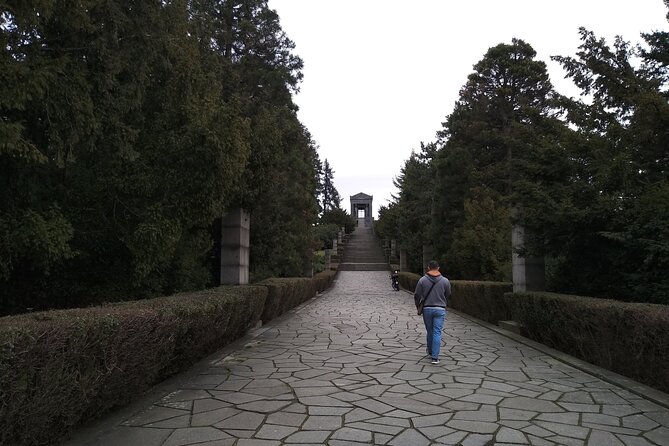
The tour begins with a drive of about 30 to 45 minutes from central Belgrade to Avala Tower. That journey is a reminder that this is not a compact walking tour. It is a full-city outing, and the vehicle is what makes the route practical.
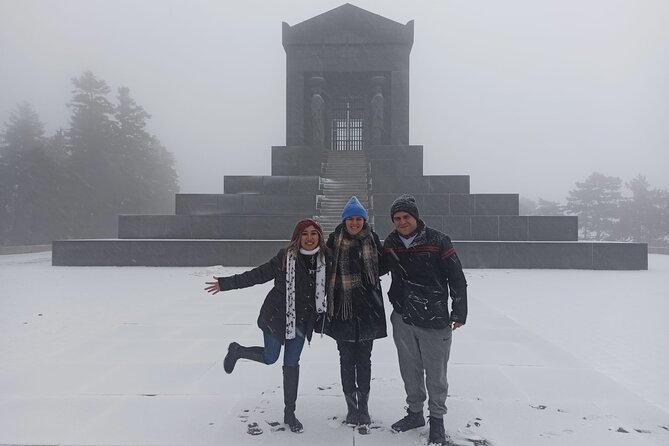
Avala Tower sits on Avala, described as Belgrade’s tallest mountain. The tower’s story gives the trip an immediate historical edge. NATO bombing destroyed the original structure in 1999, and it was rebuilt in 2010. From the observation deck, you get a broad view over Belgrade and its surrounding area.
This is the only stop with a listed admission ticket, and it is included in the tour price. The visit lasts about 45 minutes, making it the longest stop of the day. That gives you time to take in the view and hear why the tower matters, rather than making it a quick roadside photo stop.
Weather can affect the feel of this visit. One tour group reached the tower with snow on the ground, so winter conditions do not automatically cancel the experience. Still, a clear day will make the observation deck more rewarding. If the weather is poor, the tower’s history remains interesting, but the view may be limited.
Rudo, the Eastern City Gate, and socialist scale
From Avala Tower, allow another 30 to 45 minutes to reach the Eastern City Gate, officially known as Rudo. The name refers to a complex of three residential buildings, each rising about 85 meters and designed in the Brutalist style.
You will have about 20 minutes here. That is enough to study the relationship between the three towers and hear how they became one of Belgrade’s symbols of Yugoslav socialism. The buildings are not presented as isolated works of art. They are part of a larger idea about housing, density, modern life, and the ability of the state to build on a huge scale.
This is one of the stops where a guide adds real value. Without context, you might see three tall concrete blocks and move on. With an explanation of their role in the city and their place in Yugoslav design, the group becomes more legible. Look for the repetition, height, and arrangement of the towers. The design is meant to be seen as a single urban composition.
Do not expect a long interior visit. The scheduled stop is short, and the focus is on the exterior and its setting. That is typical of this route. You are seeing important structures in their actual urban surroundings, not entering a museum built to explain them.
Ada Bridge and the engineering of movement
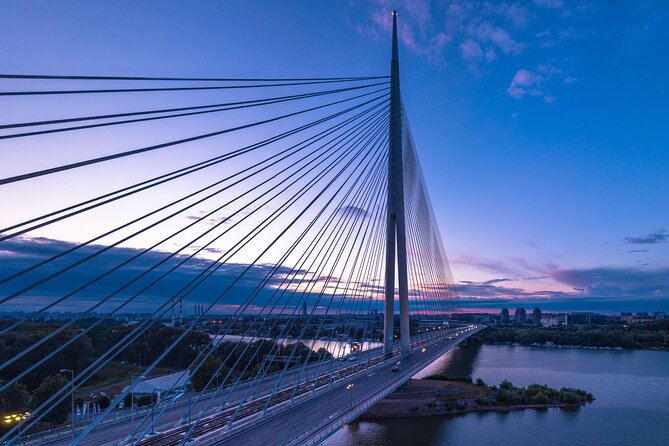
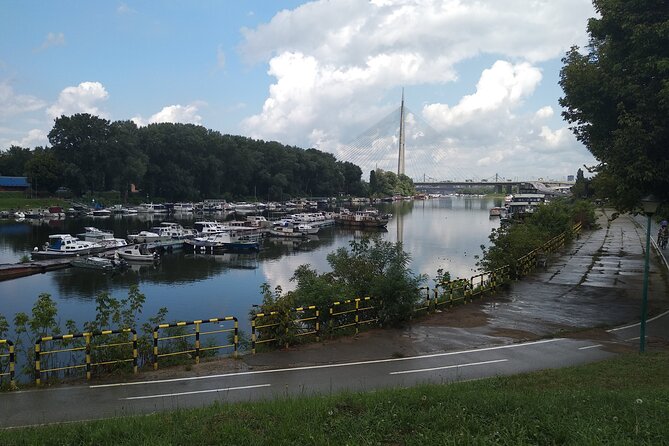
The drive from Rudo to Ada Bridge takes about 10 to 15 minutes. The bridge crosses the Sava River and is described as Europe’s highest single-pylon bridge. Its construction was featured on the Discovery Channel, adding a popular engineering story to the architectural focus.
The scheduled visit lasts around 20 minutes. You will cross the bridge and hear about its design and construction. This stop changes the rhythm of the tour. After looking at residential towers, you are now considering how a major piece of infrastructure reshapes movement across a river.
The bridge is also a useful reminder that modern architecture is not limited to buildings. Roads, pylons, cables, and river crossings can express a city’s ambition just as clearly as a government complex. I like that the route includes this kind of structure rather than treating architecture as a parade of concrete façades.
The short visit means you will not spend a long time examining every technical feature. If bridge engineering is your main interest, you may want to ask the guide specific questions during the drive. The private setting makes that easy, and the conversation can continue while you travel to the next stop.
A couple more Belgrade trips to weigh up
- From Belgrade: Novi Sad & Sremski Karlovci Full-Day Tour
★ 4.7 · 1,068 reviews - From Belgrade: Gems of Eastern Serbia Tour
★ 5.0 · 427 reviews - Northern Serbia: Sremski Karlovci and Novi Sad Full-Day Tour from Belgrade
★ 5.0 · 425 reviews - Day Trip from Belgrade: Gems of Eastern Serbia
★ 5.0 · 424 reviews
Sava Center and the shape of international politics
Only about 10 minutes separates Ada Bridge from Sava Center. The stop lasts roughly 15 minutes, and the building offers one of the clearest links between architecture and diplomacy on the route.
Sava Center was built for the 1977 Conference on European Security and Cooperation in Belgrade. It was the first and largest conference center in former Yugoslavia. The complex uses polyhedral forms and a large structural composition, giving you a chance to look at how an enormous public building handles space, movement, and symbolism.
The building was designed to host international events, so its scale makes sense when you connect it to Yugoslavia’s place between political blocs. This is where the guide’s historical background becomes particularly useful. You are not only looking at a large conference hall. You are seeing a building designed to present Belgrade as a serious international meeting place.
The 15-minute stop is brief, and the available information points to examining the structure rather than spending time inside. Go expecting an exterior architecture lesson. If access or opening arrangements change, the guide can explain what is possible on the day.
Palace of Serbia and the architecture of power
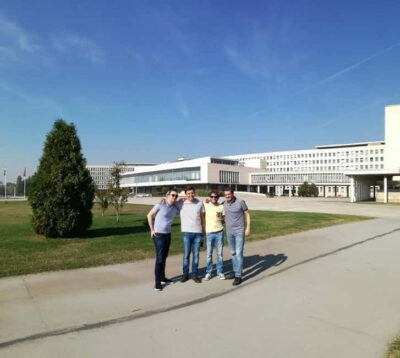
A five-minute drive brings you to the Palace of Serbia, formerly the Federal Executive Council. The building is a major example of late modernism and was the first New Belgrade project after the Second World War.
You have about 15 minutes in front of it. The building’s size is the point. It is enormous, yet the design is described as elegant, creating a useful contrast between mass and refinement. Your guide will explain how its form represented the ruling ideology and the ambitions of the new postwar state.
This is one of the most politically charged stops. Government architecture often tells you how leaders wanted the state to appear: permanent, orderly, modern, and capable of organizing society. The Palace of Serbia gives that idea a physical form.
The stop is not about entering government offices or touring a full interior. You will stand in front of the structure and study its design from the outside. That may feel short if you want architectural details, but the building is large enough that an explanation of its purpose can make the 15 minutes worthwhile.
Genex Tower, Belgrade’s Western Gate
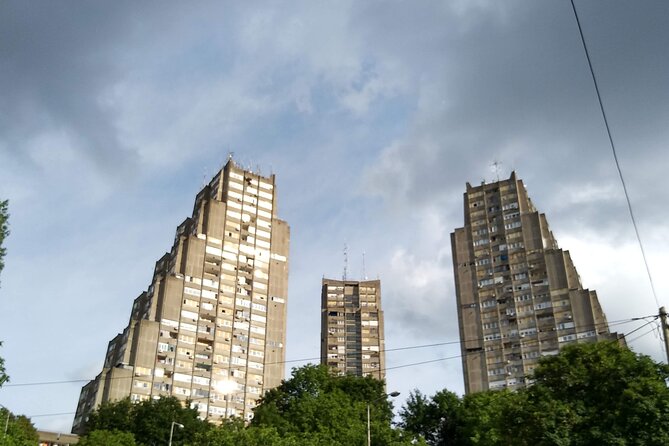
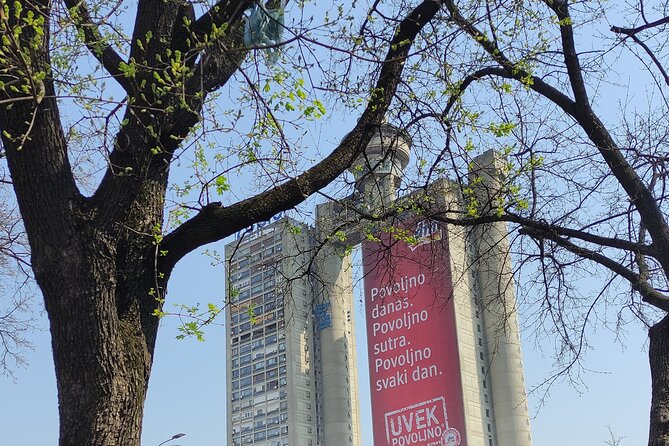
The last major stop is about 10 minutes away. The Western City Gate, better known as Genex Tower, is a 36-story skyscraper designed in 1977 by Mihajlo Mitrović. It is a Brutalist composition of two towers joined by a two-story bridge.
This is likely to be the most immediately memorable building for many people. Its unusual paired form gives it a strong silhouette, and its position at the western entrance to Belgrade helps explain the name Western City Gate. The design is not a simple vertical block. It uses separation, connection, and height to create a landmark meant to greet people arriving in the city.
You will spend around 15 minutes here. That gives you enough time to take photographs and hear how the tower fits into New Belgrade’s wider development. Ask about the difference between the two towers and the purpose of the connecting section if that interests you. The private format is helpful because you are not tied to a fixed group discussion.
Again, this is mainly an exterior visit. The tour gives you access to places that can be hard to reach efficiently, but it does not promise extended interior exploration. That distinction is important for anyone expecting a building-access tour rather than a guided city route.
Guides who turn concrete into a story
The guide can make or break an architecture tour, and this experience has earned strong praise for its human side. Stefan is described as having degrees in history and as explaining Serbian history, culture, and society alongside Brutalist design. He also shared online resources after one tour, which is useful if you want to keep exploring Belgrade after the vehicle returns you to your accommodation.
Novica is praised for passionate storytelling and for making the historical material entertaining. Mihailo is noted for his warmth and for explaining what the group was seeing from the moment they entered the vehicle. Nemanja is described as combining strong historical storytelling with kindness and enthusiasm.
You may not receive a specific guide by name, so I would not book solely to request one unless the provider confirms availability. Still, the consistent pattern is clear: the guide is expected to do more than recite dates. The best version of this tour connects design to daily life, political ideals, urban planning, and the breakup of Yugoslavia.
The driver also matters. The experience includes a separate driver, and Milos is specifically praised for calm, safe driving and for adding useful information. Since the route includes long transfers, a steady driver and a conversational guide make the time in the vehicle part of the tour rather than dead time.
What the four-hour schedule really feels like
The total duration is approximately four hours, and transportation time is already included. The listed driving times add up to roughly 95 to 125 minutes, while the stops total about 130 minutes. In practice, that leaves a fairly active schedule with limited slack.
You will spend the longest period at Avala Tower. The other five stops generally last 15 to 20 minutes, with Ada Bridge receiving about 20 minutes. This format works well for seeing many landmarks in one outing, especially when your priority is coverage and explanation.
It is less suitable if you want to sit with one building for an hour, sketch details, or study every façade at close range. You can ask the guide to spend extra time at the sites that interest you most, but doing so may mean shortening another stop.
Pickup and drop-off at your accommodation remove much of the day’s friction. The air-conditioned vehicle is included, and the private group size is capped at three people. Service animals are allowed, and most people can participate according to the available tour information.
The experience operates Monday through Sunday from 9:00 a.m. to 5:00 p.m. within the stated operating period. Confirmation is provided at booking, and free cancellation is available if you cancel at least 24 hours before the start time. Changes or cancellations made within 24 hours are not accepted for a refund.
Is $175.14 a fair price for up to three people?
At $175.14 per group, the price works out to about $58 per person for three people, or about $87.57 per person for two. A solo visitor pays the full group rate, so the value is much better when shared.
The price includes the vehicle, pickup, drop-off, professional guide, and entrance fees. Since Avala Tower is the only listed paid admission, the main value comes from private transport and expert interpretation. You are paying to connect distant places in one half-day, not simply to enter a series of attractions.
I consider that fair for architecture fans, especially if you would otherwise need to arrange multiple taxi rides or spend much of the day navigating between sites. It is harder to justify if you have no interest in modern architecture or if you prefer to explore at your own pace.
Personal expenses are not included. The supplied details do not list a meal or refreshment stop, so plan this as a focused sightseeing block rather than a relaxed day with dining built in.
Who should book this private architecture tour?
I would recommend it to anyone interested in Brutalism, Yugoslav socialist design, city planning, bridges, or the relationship between buildings and political power. Architecture students, photographers, historians, and visitors who have already seen central Belgrade will get the most from it.
It also suits you if you want a private conversation rather than a large group. With only your party participating, you can ask for more explanation, adjust the emphasis, and discuss links between Serbia and the former Yugoslavia as you go.
I would be more cautious if you dislike driving between stops, need long visits at each site, or want extensive interior access. The itinerary covers a lot of ground, but it does so through short visits and exterior viewing.
Should you book it?
Book this tour if your idea of a good Belgrade day includes concrete towers, ambitious bridges, socialist-era government buildings, and serious conversation about how cities express power. The route reaches places that are inconvenient to combine on your own, and the guide adds the context that turns unusual structures into meaningful ones.
Skip it if your time in Belgrade is limited to one day and you have not yet seen the historic center. But if you have a spare half-day, or if modern architecture is one of your main reasons for visiting Serbia, this is a smart and unusual choice. Share the cost with two companions, ask for the sites that matter most to you, and expect a fast-moving tour rather than a slow architectural workshop.
FAQ
How long does the tour last?
The tour lasts approximately four hours, including transportation time between the stops.
How many people can join the private tour?
The price covers one private group of up to three people. Only your group participates.
What is the tour price?
The listed price is $175.14 per group of up to three people.
Is pickup from my accommodation included?
Yes. Pickup and drop-off from your accommodation are included, and travelers are picked up from their stated address.
What language is the tour offered in?
The tour is offered in English.
Is admission to Avala Tower included?
Yes. Entrance fees are included, and the Avala Tower stop specifically lists admission as included.
What are the main places visited?
The route includes Avala Tower, the Eastern City Gate, also called Rudo, Ada Bridge, Sava Center, Palace of Serbia, and the Western City Gate, also known as Genex Tower.
Can I cancel for a full refund?
Yes, you can cancel for a full refund if you do so at least 24 hours before the experience start time. Cancellations or changes made less than 24 hours before the start time are not refunded or accepted.
Just added in Belgrade
- Your Own Belgrade: Street Art and Hidden Gems Walking Tour★ 5.0 · 2 reviews
- Private Half Day Serbia Tour Novi Sad and Petrovaradin Fortress★ 5.0 · 3 reviews
- 3-Hour Belgrade Zemun Neighborhood Tour★ 5.0 · 8 reviews
- Private Belgrade Street Art and Adventures Walking Tour★ 5.0 · 4 reviews
- Private Wine Tasting by Party in Belgrade★ 5.0 · 3 reviews
- From Belgrade:Uvac Nature Reserve Tour★ 5.0 · 4 reviews
- Urban & Alternative Belgrade tour★ 5.0 · 4 reviews
- VIP Reservation Service in Belgrade★ 5.0 · 2 reviews
Communist & Yugoslav History Tours, compared.

Space architecture tour – brutalist architecture
Read our review →
Browse the lists this tour appears in