
Reviewed · COMMUNIST & YUGOSLAV HISTORY TOURS
Communist Tour in Belgrade
Belgrade’s past is still visible. This three-hour Communist Tour connects Tito’s Yugoslavia, the Non-Aligned movement, the conflicts of the 1990s, and the 1999 NATO bombing through central city landmarks. I especially like the small maximum group of 15 and the thoughtful route from Republic Square to the Museum of Yugoslavia. The price, about $24.03, also gives you a lot for an afternoon in Belgrade.
I like that the tour does not stop at grand political stories. It includes the damaged General Staff building, a trolleybus ride, and Tito’s grave at the House of Flowers. The main consideration is pace: several stops last only 15 minutes, so you need to listen closely and save detailed questions for the guide.
In This Review
- Key points to know before booking
- Why this tour helps explain modern Belgrade
- Starting at Republic Square with Tito and the 1990s
- Socialist Realism at mts Dvorana
- The National Assembly and the changing Yugoslav state
- Kneza Miloša and the street of embassies
- Generalštab: architecture damaged by war
- The trolleybus ride to the Museum of Yugoslavia
- One hour at the Museum of Yugoslavia
- What the $24.03 price really includes
- Who will get the most from this afternoon tour?
- Should you book the Communist Tour in Belgrade?
- FAQ
- Where does the Communist Tour in Belgrade begin?
- What time does the tour start?
- Where does the tour finish?
- How long does the experience last?
- Is admission to the Museum of Yugoslavia included?
- Is public transportation part of the tour?
- How far in advance can I cancel?
Key points to know before booking
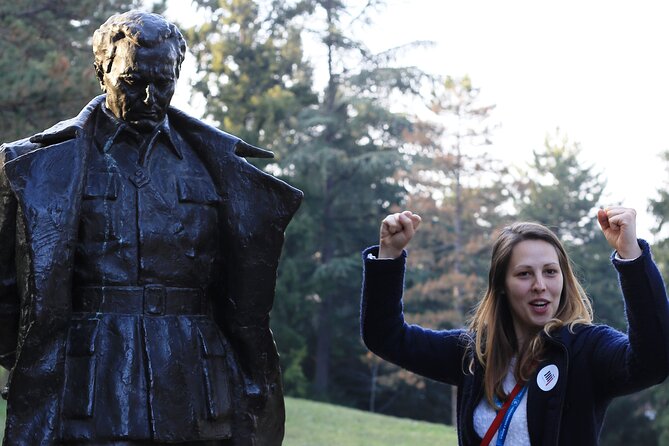
- Tito’s story anchors the tour, including the famous Youth Relay Baton and Yugoslavia’s role in the Non-Aligned movement.
- Generalštab gives the tour its strongest visual moment, with its post-war design and severe damage from the 1999 NATO bombing.
- The Museum of Yugoslavia is included, with about one hour inside and access to Tito’s grave at the House of Flowers.
- A trolleybus ride links the city center with the museum, and the ticket is included in the price.
- The tour runs in English at 3:00 pm, beginning at Republic Square and ending at the Museum of Yugoslavia.
- Guides such as Stefan, Michael, and Milan have earned strong praise for clear English, careful presentation, and insight into difficult modern history.
Why this tour helps explain modern Belgrade
Belgrade can look like a city of cafés, river views, and grand old buildings. But the political story beneath the surface is complicated. Serbia was part of several different states during the 20th century, and the period of socialist Yugoslavia still shapes how many people understand the country today.
This tour gives you a useful framework. It covers Josip Broz Tito, the political system he led, Yugoslavia’s position between the Cold War blocs, the breakup of the country, the wars of the 1990s, the NATO bombing, and the democratic changes that followed.
That range is a major strength. You are not getting a tour focused only on Communist architecture or only on Tito memorabilia. Instead, you move from political symbols in the city center to places connected with government, military power, public memory, and national mourning.
The subject needs care. Tito’s rule, Yugoslav identity, Serbian nationalism, the wars, and the NATO bombing remain sensitive topics. The strongest guides, including Stefan and Milan, are praised for presenting events objectively and with nuance. That matters here. A simple good-versus-bad story would leave you with a poor understanding of the period.
The English-language format also helps visitors who know little about Yugoslavia. One guide, Stefan, has been praised for his command of English and for suggesting books and documentaries after the tour. That kind of follow-up is useful if the tour sparks a larger interest in the region.
Other tours covering the Yugoslav decades:
- Red Belgrade Communist Tour
★ 4.8 · 301 reviews - Red Belgrade Communist Tour
★ 5.0 · 78 reviews - Belgrade: Yugoslavia Communist tour
★ 4.8 · 66 reviews
Starting at Republic Square with Tito and the 1990s
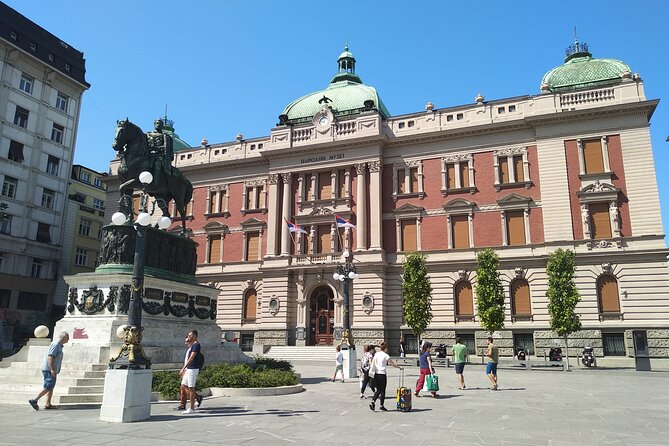
The meeting point is Trg Republike, or Republic Square, in central Belgrade. The opening stop lasts about 15 minutes and is free to enter, since the square itself is the setting.
This is a sensible place to begin. Republic Square is one of the city’s main public spaces, so the guide can introduce the political story before you start looking at buildings. The discussion includes Tito’s public image, the Youth Relay Baton, the Non-Aligned movement, the conflicts of the 1990s, NATO’s 1999 bombing of Serbia and Montenegro, and the democratic changes at the start of the new millennium.
The Youth Relay Baton is one of the more unusual subjects. It was tied to Tito’s birthday and became a major symbolic event in Yugoslav public life. It helps show how political loyalty was expressed through ceremonies, youth groups, and mass participation, rather than only through official speeches.
The Non-Aligned movement also gives the tour an international angle. Yugoslavia did not fit neatly into the Soviet or Western camp during the Cold War. That position shaped its foreign policy and helped give the country a role larger than its size might suggest.
You should pay close attention here, because the opening explanation sets up nearly everything that follows. The square itself is not the main attraction of this stop. Its value comes from the guide’s interpretation.
Socialist Realism at mts Dvorana
A short walk brings the group to mts Dvorana, formerly known as Dom Sindikata, or Trade Union Hall. The stop lasts about 15 minutes.
The building was designed by Branko Petričić, with construction beginning in 1947. Its large scale and Socialist Realist style make it a clear example of the public architecture associated with the early postwar period.
This stop helps you see how ideology entered everyday city life. A trade union hall was not simply a practical building. It was part of a new social order that presented workers, collective activity, and state institutions as central features of public life.
You will not spend long inside, and the tour data does not promise an interior visit. Think of this as an architectural and political explanation from the street. The guide’s comments should help you notice the relationship between the building’s size, its formal design, and the message it was meant to send.
The short timing keeps the tour moving, but it also means this is not a detailed architecture lesson. If Socialist Realism is your main interest, you may want to take a few minutes to look closely at the building before the group continues.
The National Assembly and the changing Yugoslav state
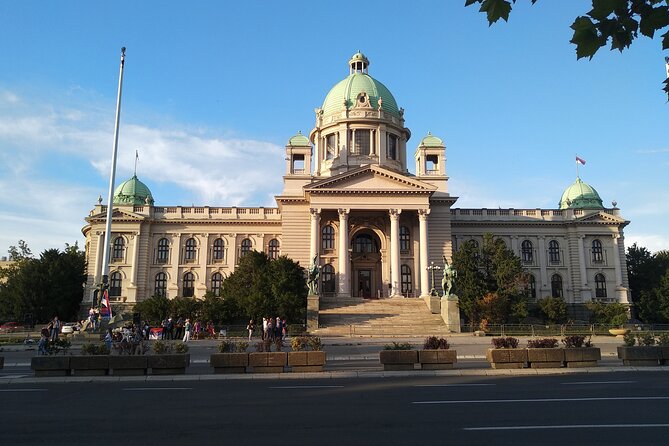
The next stop is the House of the National Assembly of the Republic of Serbia, located on Nikola Pašić Square. The group spends about 15 minutes here.
The building was completed in 1936. It later served as the seat of the Parliament of Yugoslavia and the Parliament of Serbia and Montenegro, before becoming the home of Serbia’s National Assembly. That changing role makes it a useful place to discuss the political shifts of the 20th century.
You get a physical sense of how one building can outlast several different political systems. The architecture belongs to an earlier period, but the institution inside it changed as the Kingdom of Yugoslavia, socialist Yugoslavia, Serbia and Montenegro, and modern Serbia followed one another.
The stop is less about Communist design than it is about government and continuity. The guide can connect the building to the broader question of how Yugoslav federal structures worked and how authority changed after the country began to break apart.
Again, the time is brief. You are unlikely to receive every detail about the building or Serbian politics. The benefit is the larger context, especially if you are still trying to understand the difference between Yugoslavia, Serbia and Montenegro, and today’s Serbia.
A couple more Belgrade trips to weigh up
- From Belgrade: Novi Sad & Sremski Karlovci Full-Day Tour
★ 4.7 · 1,068 reviews - From Belgrade: Gems of Eastern Serbia Tour
★ 5.0 · 427 reviews - Northern Serbia: Sremski Karlovci and Novi Sad Full-Day Tour from Belgrade
★ 5.0 · 425 reviews - Day Trip from Belgrade: Gems of Eastern Serbia
★ 5.0 · 424 reviews
Kneza Miloša and the street of embassies
Kneza Miloša Street receives about 20 minutes, making it one of the longer outdoor stops.
The street was once the city’s main korzo, or promenade. Today it is a major traffic route and home to important national institutions and many embassies. That contrast gives the guide a chance to talk about how Belgrade’s public spaces changed over time.
This part of the route is useful because it connects politics to ordinary urban movement. A street used for strolling and social display became a major artery lined with government buildings and foreign missions. You can see how the city’s role as a national capital and diplomatic center developed.
The stop may feel less dramatic than Generalštab or the museum. There is no single object or memorial to hold your attention. Its value depends heavily on the guide’s explanation and on your willingness to look at the street as a working part of the city rather than as a formal sightseeing monument.
At this point, the tour also begins shifting from broad civic history toward the military and diplomatic crises of the late 20th century.
Generalštab: architecture damaged by war
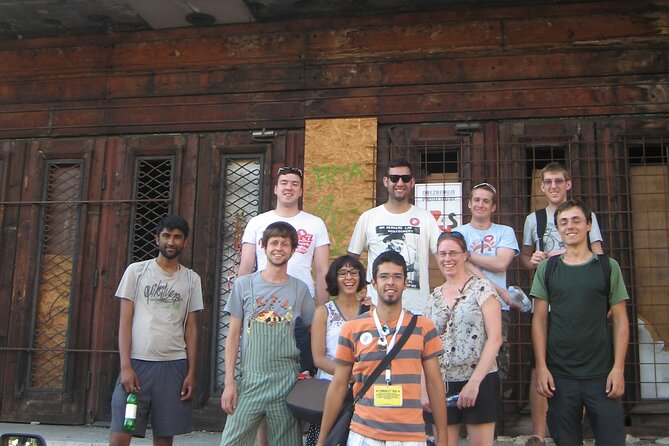
Generalštab is the tour’s most powerful outdoor stop. The group spends about 15 minutes at the former Yugoslav Ministry of Defence and General Staff building.
The complex is considered a major example of postwar architecture. Its design once represented the strength and authority of the Yugoslav state. In 1999, it was heavily damaged during the NATO bombing of Yugoslavia, and the ruins remain a visible reminder of that conflict.
The building’s condition gives the historical discussion a physical focus. You are not only hearing about NATO air strikes or the political disputes behind them. You are looking at a structure that still carries the marks of the event.
This stop can be emotionally difficult. The bombing is not ancient history, and the questions around the Kosovo conflict, NATO intervention, Serbian politics, and civilian impact remain contested. A good guide needs to explain the competing views without turning the visit into a political speech.
The praise for Stefan, Michael, and Milan centers on precisely this kind of work. Stefan is described as fact-based and nuanced, Michael as passionate and able to bring the subject to life, and Milan as objective in his presentation of both the distant and recent past.
You should also understand that the building is viewed from outside. The 15-minute stop is enough to grasp its importance and see the damage, but not enough for a long architectural study.
The trolleybus ride to the Museum of Yugoslavia
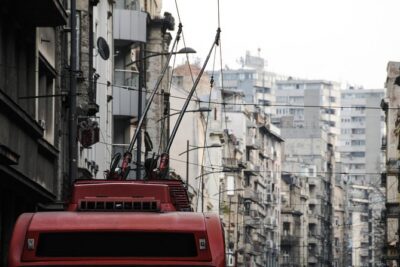
After Generalštab, the group takes a trolleybus to the Museum of Yugoslavia. The ride takes about 15 minutes, and the ticket is included.
This is a small but worthwhile part of the experience. You are not simply transferred in a private vehicle while the city disappears behind dark windows. You use local public transport, which gives the route a more ordinary Belgrade feel and lets the guide explain how the transport system works.
Michael has been praised for his familiarity with the transit system. That is a useful skill on a tour like this, because the trolleybus ride is part of the planned route rather than an optional extra.
The ride also creates a natural pause between the central city stops and the museum visit. You have covered public squares, government buildings, embassies, and a bombed military complex. The museum then shifts the focus toward memory, objects, and Tito’s personal legacy.
The transport element may be less comfortable for someone who prefers a private coach or has difficulty boarding public vehicles. The tour information says most people can participate and that the route is near public transportation, but it does not provide detailed accessibility information. If that matters to you, ask the operator before booking.
One hour at the Museum of Yugoslavia
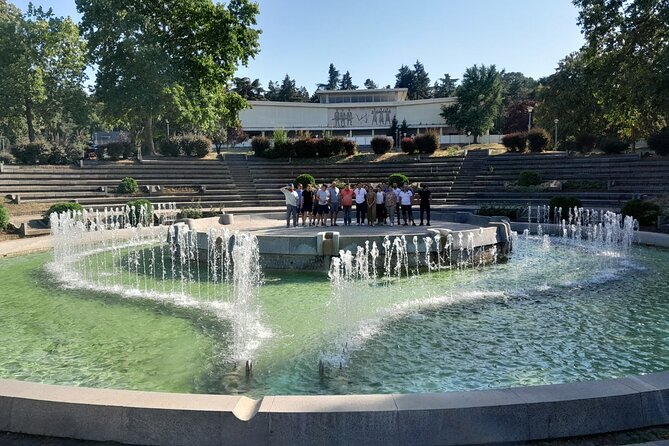
The Museum of Yugoslavia is the tour’s main indoor visit, with about one hour included. Admission is part of the $24.03 price, which makes the overall value stronger than a walking tour that ends at the museum door.
The museum covers the Kingdom of Yugoslavia, socialist Yugoslavia, and the life of Tito. This broad scope matters because it places the Communist period inside the longer story of the Yugoslav state, rather than treating it as an isolated chapter.
The museum is also connected directly to Tito’s memory. His grave is located in the House of Flowers, one of the museum buildings. For many visitors, this is the emotional center of the tour. Tito is presented not only as a political leader but also as a figure whose image, rituals, and personal legacy shaped public life.
The museum receives about 120,000 visitors each year and is described as the most visited museum in Serbia. That popularity does not mean you should expect a quick, simple display. One hour gives you a guided introduction, but you may want to return later if you want to examine everything carefully.
The group spends the final hour here, so the guide can explain objects and themes in more detail than at the outdoor stops. You should use this time to ask questions. The museum is where the earlier discussion of the Youth Relay Baton, Tito’s public image, and Yugoslavia’s political system comes together.
The tour ends in front of the museum at Mihaila Mike Jankovića 6, Belgrade 11000. You are not returned to Republic Square, so plan the rest of your afternoon from the museum area.
What the $24.03 price really includes
At about $24.03 per person, this is a fair price for a three-hour guided experience. You receive an English-speaking professional guide, entry to the Museum of Yugoslavia, and the trolleybus ticket.
The value is strongest if you want context. You could walk past Republic Square, Dom Sindikata, the National Assembly, Kneza Miloša, and Generalštab on your own, but you would miss the links between them. The guide supplies the political thread, then carries it into the museum.
The cost also compares well with the amount of time involved. The tour lasts approximately three hours, with about an hour at the museum and several short city-center stops. Personal expenses are not included, but there are no listed extra entrance charges during the route.
Group discounts are available, which may help if you are booking for several people. The group is capped at 15, a useful limit for a subject that requires explanation and questions. A very large group would make the street stops and museum discussion harder to follow.
The main limit is not price but depth. Three hours can introduce Yugoslav history, but it cannot settle every dispute or explain every stage of the breakup in detail. Think of this as a strong orientation, with enough substance to guide your own reading afterward.
Who will get the most from this afternoon tour?
I would recommend this experience to you if you want to understand the political background behind Belgrade’s buildings and memorials. It is especially useful if you have little prior knowledge of Yugoslavia.
The tour suits visitors who enjoy history presented through places. You move from a central square to a Socialist Realist building, a national parliament, a diplomatic street, a damaged military headquarters, and finally a museum devoted to Yugoslavia and Tito.
It also suits anyone interested in 20th-century Europe beyond the usual Western European route. The Non-Aligned movement, Yugoslavia’s position during the Cold War, and the 1990s conflicts are important subjects that are often simplified in general sightseeing tours.
You may want a different experience if you prefer light sightseeing, lots of free time, or a tour devoted mainly to architecture. The material is serious, and the short stop lengths require attention. The best approach is to arrive ready to listen rather than expecting a casual stroll.
The start time is 3:00 pm, which leaves your morning and early afternoon open. The tour is offered in English, and confirmation is provided when you book. It is typically booked around 16 days ahead, so reserving early is sensible if your Belgrade dates are fixed.
Free cancellation is available if you cancel at least 24 hours before the start time. Changes made inside that period are not accepted, and a minimum number of participants is required for the tour to operate.
Should you book the Communist Tour in Belgrade?
Book it if you want a clear, place-based introduction to Tito’s Yugoslavia and the events that shaped modern Serbia. The combination of expert guide commentary, Generalštab, public transport, and the Museum of Yugoslavia gives you far more context than a simple city walk.
I would be particularly happy to book with a guide such as Stefan, Michael, or Milan, based on the strong praise for their English, historical command, transit skills, and balanced approach. The tour is not a complete study of Yugoslav history, but it is a practical starting point and a good value at $24.03.
Skip it only if you want a relaxed tour with little political discussion. For everyone else, this is one of the more useful ways to see Belgrade’s recent past in the places where it actually happened.
FAQ
Where does the Communist Tour in Belgrade begin?
The tour begins at Trg Republike, Republic Square, in Belgrade.
What time does the tour start?
The start time is 3:00 pm.
Where does the tour finish?
The tour ends in front of the Museum of Yugoslavia at Mihaila Mike Jankovića 6, Belgrade 11000, Serbia.
How long does the experience last?
The tour lasts approximately three hours.
Is admission to the Museum of Yugoslavia included?
Yes. Museum admission is included in the tour price, with about one hour scheduled inside.
Is public transportation part of the tour?
Yes. The group takes a trolleybus from the Generalštab building to the Museum of Yugoslavia. The trolleybus ticket is included.
How far in advance can I cancel?
You can cancel for a full refund up to 24 hours before the experience start time. Cancellations or changes made less than 24 hours in advance are not accepted for a refund.
Just added in Belgrade
- Your Own Belgrade: Street Art and Hidden Gems Walking Tour★ 5.0 · 2 reviews
- Private Half Day Serbia Tour Novi Sad and Petrovaradin Fortress★ 5.0 · 3 reviews
- 3-Hour Belgrade Zemun Neighborhood Tour★ 5.0 · 8 reviews
- Private Belgrade Street Art and Adventures Walking Tour★ 5.0 · 4 reviews
- Private Wine Tasting by Party in Belgrade★ 5.0 · 3 reviews
- From Belgrade:Uvac Nature Reserve Tour★ 5.0 · 4 reviews
- Urban & Alternative Belgrade tour★ 5.0 · 4 reviews
- VIP Reservation Service in Belgrade★ 5.0 · 2 reviews
Communist & Yugoslav History Tours, compared.
Space architecture tour – brutalist architecture
Read our review →
Private 4 Hours Space Architecture Tour in Belgrade
Read our review →
Browse the lists this tour appears in