Reviewed · BELGRADE TOURS
NATO Bombing of Belgrade Private Tour
Belgrade’s scars tell a hard story. This private tour connects five bombing sites with clear explanations, old photographs, and the personal cost of the 1999 NATO campaign. I especially like the small private format and the use of visual material at each stop. I also like that hotel or port pickup is included. The main drawback is that the tour focuses closely on one painful chapter, so it may feel heavy rather than lighthearted.
You get roughly three to four hours with a private guide and driver, bottled water, and transport between sites. At $145.10 per person, the value depends on your group size: it is easier to justify for several people sharing the private vehicle than for one person paying alone. The 10:00 a.m. start also leaves the rest of your day free, but you should be ready for a serious, emotionally charged history lesson.
In This Review
- Key points to know before booking
- Why this Belgrade tour matters
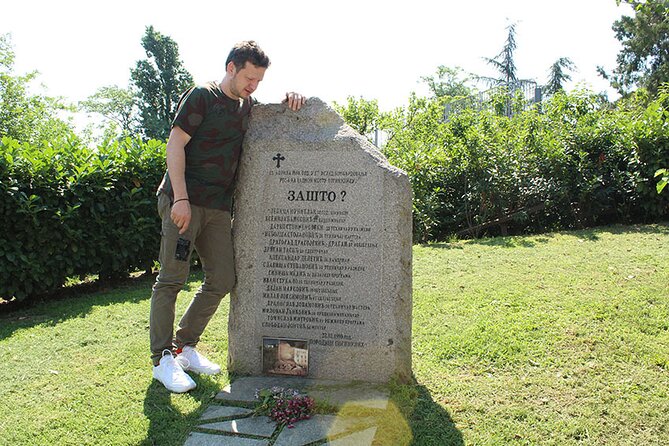
- RTS and the memorial called Zašto?
- The Ministry of Defence and April 29, 1999
- Ušće, the former Communist Party headquarters
- The former Chinese embassy and the most disputed attack
- Air Force Command and the final story
- How the private vehicle changes the experience
- Is $145.10 per person fair value?
- Who should book this experience?
- Final verdict: book it for focused recent history
- FAQ
- How long does the NATO Bombing of Belgrade Private Tour last?
- What time does the tour start?
- Is hotel pickup included?
- Can I be picked up from an Airbnb or apartment?
- Is pickup available from Belgrade port?
- What language is the tour offered in?
- Is this a private tour?
- Are admission tickets included?
- Can I cancel for a full refund?
Key points to know before booking
- Five major bombing sites in one morning: The route covers RTS, the Ministry of Defence, Ušće, the former Chinese embassy site, and Air Force Command.
- The RTS building remains unrepaired: A memorial called Zašto?, or Why?, marks the death of 16 mostly young night-shift workers.
- Private transport keeps the tour efficient: Pickup and drop-off are offered from hotels, listed locations, apartments, Airbnbs, and Belgrade’s cruise port.
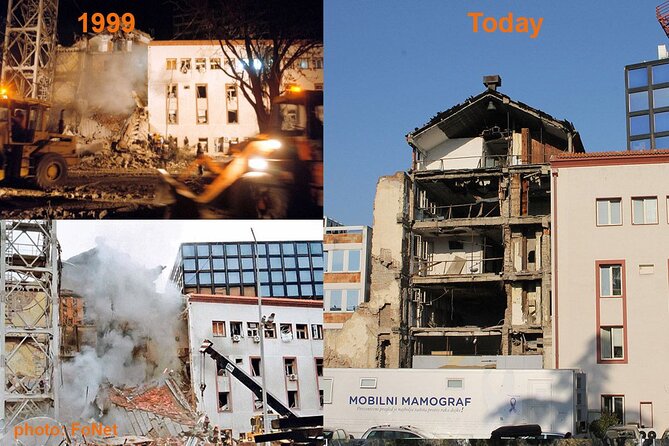
- Visual storytelling adds context: Photographs help connect today’s buildings and ruins with what happened in 1999.
- The former Chinese embassy is the most controversial stop: Four Chinese citizens died there on May 7, 1999.
- The tour is educational but emotionally weighty: It suits people who want recent political and military history, not a casual city sightseeing ride.
Why this Belgrade tour matters
Belgrade is full of older landmarks, but the bomb damage from 1999 is still part of the city’s daily view. Some damaged buildings were repaired. Others remain as they were, deliberately or practically, leaving a direct reminder of the conflict.
I like the way this tour lets you see those places in one connected route. Instead of spotting a damaged facade by chance, you learn what happened there, why the site was targeted, and who was affected. That context makes the buildings easier to understand, even when the explanations raise difficult political questions.
The tour is private, so only your group participates. That gives you room to ask questions and control the pace more easily than on a large bus excursion. The guide also drives, which matters in Belgrade, where the sites are spread across different parts of the city.
The experience has an average rating of 4.3 from 11 reviews, a useful sign that the tour has generally worked well but does not offer a huge body of feedback to rely on. The strongest praise centers on its educational value and its visual presentation. You should expect history, discussion, and firsthand places, not entertainment dressed up as sightseeing.
A couple more Belgrade trips to weigh up
- From Belgrade: Novi Sad & Sremski Karlovci Full-Day Tour
★ 4.7 · 1,068 reviews - From Belgrade: Gems of Eastern Serbia Tour
★ 5.0 · 427 reviews - Northern Serbia: Sremski Karlovci and Novi Sad Full-Day Tour from Belgrade
★ 5.0 · 425 reviews
RTS and the memorial called Zašto?
The first stop is the RTS, or Radio Television of Serbia, building. The guide begins beside the monument named Zašto?, which means Why?
This is one of the most difficult stops because the story centers on civilians at work. During the night shift, 16 people, mostly young, were killed when the building was struck. Part of the original building remains unrepaired, giving the site a physical memorial as well as a written one.
I find this a strong opening because it immediately puts human lives ahead of military strategy. You are not simply looking at a damaged structure. You are hearing about workers who were inside during a night shift, and about a building that still carries the evidence of that event.
The stop lasts about 30 minutes. That is enough time for an explanation and photographs without turning the visit into a long stationary lecture. The admission cost is free, as it is at every stop on the route.
One point to keep in mind: the RTS site may be emotionally harder than the later stops. If you prefer to begin a history tour with broad political background, this route instead begins with loss. That choice gives the morning force, but it also sets a serious tone that continues throughout.
The Ministry of Defence and April 29, 1999
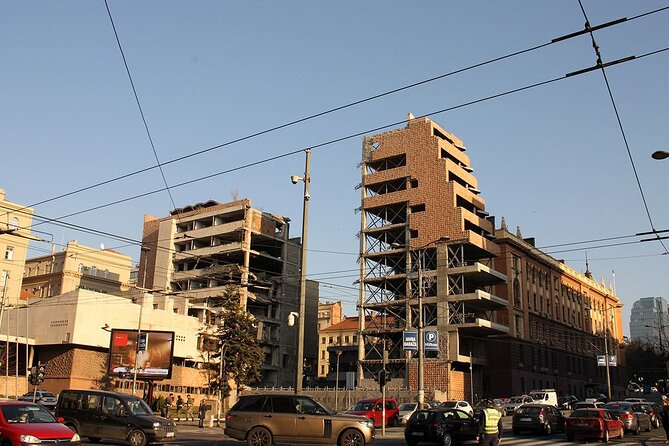
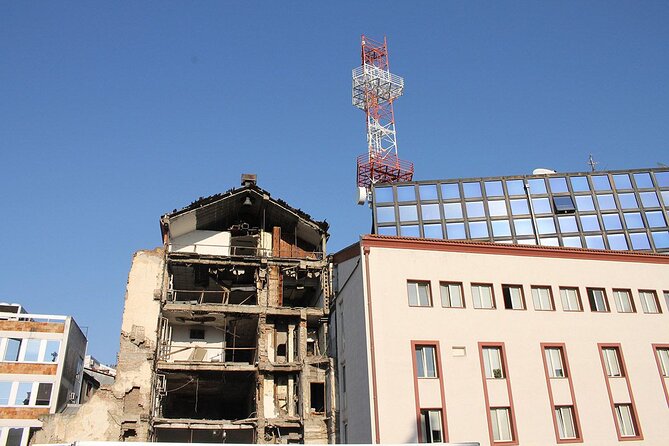
The Ministry of Defence is probably the image most closely associated with NATO bombing in Belgrade. Its damaged structure appears in many photographs, and the guide uses the site to explain the attack on the night of April 29, 1999.
Many military objectives were hit that night. One person died, and civilian buildings nearby were damaged. The setting helps you see how military targets and ordinary city life were not separated by some distant battlefield. The damage affected the surrounding urban area as well.
This 30-minute stop is useful for understanding why the building became such a powerful symbol. Its broken sections are not hidden behind a museum display. They remain part of the city, visible beside streets and newer activity.
I would pay close attention to the guide’s explanation of the nearby civilian damage. The building itself naturally attracts attention, but the wider point is how an attack on a military objective can affect people and structures beyond that target.
There is no admission charge, and you do not need to plan a separate visit. The driver-guide takes you directly from the first location, which keeps the route moving and avoids the need to work out public transport between sites.
Ušće, the former Communist Party headquarters
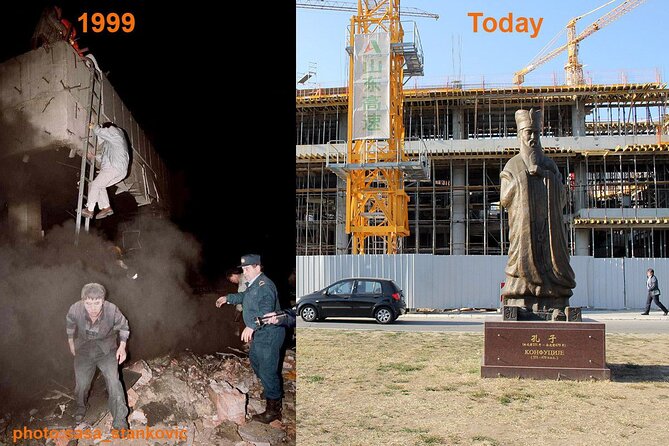
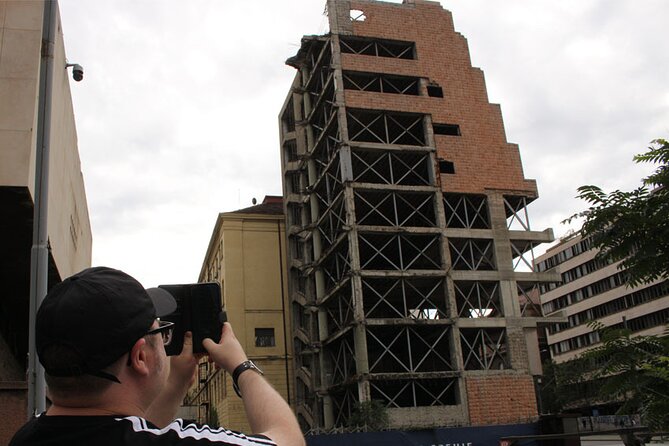
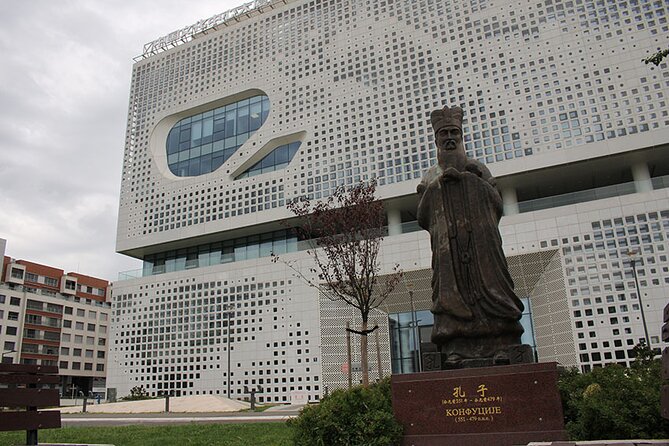
The next stop is Poslovni centar Ušće, now a business center. Its structure was once the Central Committee of the Communist Party of Yugoslavia. The current building uses the skeleton and appearance of the original construction.
This stop adds political context to the tour. The building was not simply another office tower caught in a bombing campaign. Its former role made it a symbol of the Yugoslav state and Communist Party power.
The guide explains why the building was considered resistant to NATO missiles in 1999 and why it was targeted in the first place. That combination is what makes the stop worth your time. You hear about both the building’s physical design and its political meaning.
The phrase missile proof can sound simple, but the important point is that protection did not make the building irrelevant. A structure can be difficult to destroy and still carry symbolic value as a target. The guide’s explanation should help you separate those two ideas.
Again, the stop lasts about 30 minutes. You are viewing the building from the outside, so the value comes from the explanation and the connection to the former state system. If you want interiors, museum displays, or a long architectural visit, this tour does not promise those things.
Out of the city, and a slower way to spend the day:
- Day Trip from Belgrade: Gems of Eastern Serbia
★ 5.0 · 424 reviews - Belgrade: Sunset Cruise with Live Guide
★ 4.4 · 418 reviews - Belgrade: Underground Tour with Riverside Sparkling Wine
★ 4.8 · 411 reviews - Western Serbia 1-Day Tour of the Key Sites from Belgrade
★ 4.8 · 333 reviews
The former Chinese embassy and the most disputed attack
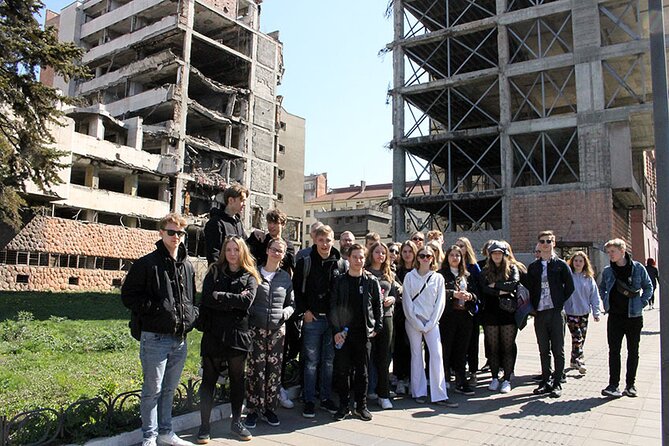
The former Chinese embassy is described as the most controversial bombing site in Belgrade. Four Chinese citizens died here on May 7, 1999.
The official explanation was that the embassy was hit because of an intelligence mistake. The site also carries suspicions that it served another purpose. The guide presents that controversy as part of the story, but you should expect an account shaped by the political sensitivity of the event.
This is an important distinction. A good history tour does not need to pretend that every question has one uncontested answer. At this stop, you are dealing with competing explanations, civilian deaths, and international consequences.
The visit lasts about 30 minutes and is free. As with the other locations, the meaning comes from the guide’s account and the physical setting rather than from an admission ticket or formal museum exhibition.
I like this stop for the questions it raises, but it may also be the point where you most want to ask careful follow-up questions. The subject is politically sensitive, and the supplied tour details do not promise a neutral academic lecture. Go prepared to listen closely and separate confirmed events from disputed claims.
Air Force Command and the final story
The final stop is the Air Force Command Building, a 1935 structure known for its Yugoslav and Serbian architectural design. It was hit by two missiles on April 5, 1999.
The building gives the tour a different visual focus. Earlier stops emphasize a television station, a government ministry, a political symbol, and an embassy. Here, the guide also discusses architecture and military history.
You will hear about the pilots who knowingly entered the fight and lost their lives defending the skies above Serbia and Yugoslavia against a much stronger NATO air force. That account presents the conflict from the Serbian military perspective and gives the final stop a personal focus.
The building’s age matters. This was not only a strategic objective. It was also a notable work of 1935 architecture. Seeing it in relation to the bombing helps explain why damaged historic or architecturally important buildings can carry meaning beyond their official function.
The stop lasts around 30 minutes. Finishing here works well because it moves from the human cost of the RTS attack through military and political targets, then ends with the pilots and the damaged command building. You leave with several viewpoints, though the tour’s subject remains centered on Serbia’s experience of the campaign.
How the private vehicle changes the experience
The tour includes a private guide and driver, hotel pickup and drop-off, and bottled water. Pickup can also be arranged from an apartment or Airbnb if you provide the location. Cruise passengers can request collection at Belgrade port.
That flexibility is one of the strongest practical features. You do not have to reach an unfamiliar meeting point before 10:00 a.m., and you do not need to organize transport between five sites. The driver handles the route while the guide explains the history.
The private setup is especially useful if your group has different levels of interest. You can ask for more detail at the RTS building, clarify the political background at Ušće, or discuss the embassy controversy without worrying about a coach full of strangers.
The tour is offered in English. Confirmation normally arrives at booking, although reservations made within 20 hours of departure are confirmed as soon as possible and depend on availability. Free cancellation is available up to 24 hours before the start time. Changes or cancellations inside that window are not accepted for a refund.
The schedule is listed as approximately three to four hours. Each of the five stops is planned for about 30 minutes, leaving time for pickup, driving, and the guide’s explanations. Since traffic and the exact pickup point can affect the morning, do not plan an appointment immediately after the stated finish.
Is $145.10 per person fair value?
The listed price is $145.10 per person. That is not a cheap half-day outing, especially for a solo participant. But this is a private tour, not a standard group excursion, and the price includes a driver-guide, vehicle transport, hotel or port pickup and return, and bottled water.
For a couple, family, or small group, the cost may feel more reasonable because you are paying for a private service rather than buying five separate visits. Group discounts are also offered, so ask about the total price before deciding.
There are no admission fees at the stops, but that does not mean the tour is priced around tickets. You are paying for access to the guide’s explanation, the route planning, and the ability to see several scattered locations in one morning.
Food and drinks beyond the bottled water are not included. Personal expenses are also your responsibility. Since the tour lasts only three to four hours, this is not a major issue, but you may want to arrange your own meal afterward.
Who should book this experience?
I would recommend this tour to you if recent European history, military decisions, political symbolism, and memorial sites are central to your interests. It is also a strong choice if you want to understand why certain damaged buildings remain part of Belgrade’s visual identity.
The tour suits first-time visitors who want a focused history morning, as well as repeat visitors who have already seen the main fortress, churches, and central squares. The private vehicle is useful if you are staying outside the main tourist center or arriving by cruise ship.
You may want to skip it if you are looking for a cheerful introduction to Belgrade, broad sightseeing, or a tour filled with interiors and formal exhibits. The subject includes deaths, destroyed buildings, disputed intelligence, and military loss. The educational value is high, but the mood is serious.
It is also worth remembering that this is one national perspective on a contested war. You can gain a great deal from the Serbian viewpoint, especially if you listen carefully and ask questions. For a fuller picture, pair the tour with your own reading from more than one source.
Final verdict: book it for focused recent history
I would book this tour if you want a direct look at Belgrade’s 1999 bombing sites and prefer a private guide over a large group. The combination of RTS, the Ministry of Defence, Ušće, the former Chinese embassy, and Air Force Command gives you a clear three to four hour route through the campaign’s human, political, military, and architectural effects.
The best reason to go is the visual storytelling. Photographs paired with the actual buildings can make the history easier to follow, especially at RTS and the Ministry of Defence. The main caution is the price for a solo guest and the serious tone.
For a group sharing the cost, I see solid value. For a history-minded visitor with limited time in Belgrade, this is a focused and efficient morning that adds context you are unlikely to get from simply passing the damaged buildings on your own.
FAQ
How long does the NATO Bombing of Belgrade Private Tour last?
The tour lasts approximately three to four hours.
What time does the tour start?
The listed start time is 10:00 a.m.
Is hotel pickup included?
Yes. Hotel pickup and drop-off are included.
Can I be picked up from an Airbnb or apartment?
Yes. You should specify the address if it is not one of the listed pickup locations.
Is pickup available from Belgrade port?
Yes. Pickup can be arranged from the port where cruise boats dock.
What language is the tour offered in?
The tour is offered in English.
Is this a private tour?
Yes. Only your group participates in the activity.
Are admission tickets included?
There are no admission charges listed for the five stops. The tour includes the guide and driver, transport, and bottled water.
Can I cancel for a full refund?
Yes, if you cancel at least 24 hours before the experience start time. Cancellations made less than 24 hours before the start time are not refunded.
Just added in Belgrade
- Your Own Belgrade: Street Art and Hidden Gems Walking Tour★ 5.0 · 2 reviews
- Private Half Day Serbia Tour Novi Sad and Petrovaradin Fortress★ 5.0 · 3 reviews
- 3-Hour Belgrade Zemun Neighborhood Tour★ 5.0 · 8 reviews
- Private Belgrade Street Art and Adventures Walking Tour★ 5.0 · 4 reviews
- Private Wine Tasting by Party in Belgrade★ 5.0 · 3 reviews
- From Belgrade:Uvac Nature Reserve Tour★ 5.0 · 4 reviews
- Urban & Alternative Belgrade tour★ 5.0 · 4 reviews
- VIP Reservation Service in Belgrade★ 5.0 · 2 reviews
Belgrade Tours, compared.
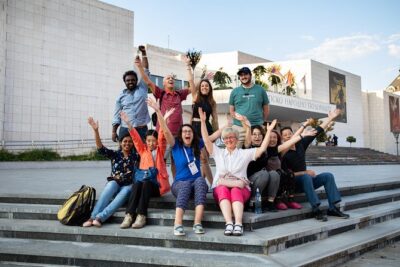
Northern Serbia: Sremski Karlovci and Novi Sad Full-Day Tour from Belgrade
Read our review →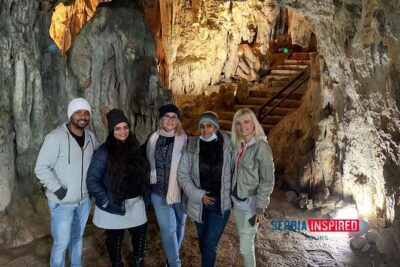
Day Trip from Belgrade: Gems of Eastern Serbia
Read our review →
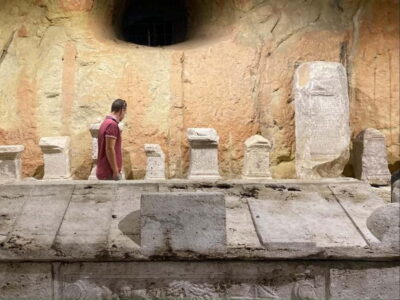
Western Serbia 1-Day Tour of the Key Sites from Belgrade
Read our review →