Reviewed · BELGRADE TOURS
Architecture of New Belgrade – Brutalism Decoded
Concrete tells Belgrade’s story. This private tour makes New Belgrade’s brutalist architecture easier to read, linking bold buildings with Yugoslavia’s politics and daily life. I like the close look at Genex Tower and the personal stories about life in the housing blocks. The main drawback is that the tour can feel brief if you want long interior visits or extensive time at every stop.
I also like the private format, since you can ask questions without competing with a large group. Guide Xenia has earned special praise for explaining both architecture and ordinary city life. Still, one poor experience reported less than two hours of touring and little personal connection, so timing and guide quality may matter here.
- Genex Tower close-up: See one of Belgrade’s most striking concrete landmarks, a 30-floor building once regarded as the Balkans’ first smart building.
- Museum of Contemporary Art start: Examine the museum’s 1960s modernist forms and costly marble facades.
- Non-Aligned Movement context: Visit the Park of Friendship, where heads of state planted trees for peace in 1961.
- Block 23’s complete community: Learn how apartments, a school, kindergarten, sports courts, and shops were planned together.
- Sava Center finish: See a huge congress building still in use, with interiors that remain surprisingly fresh.
- Private touring: Your group alone joins the guide, making this a good fit for questions and conversation.
In This Review
- Why New Belgrade Rewards a Closer Look
- The Museum of Contemporary Art and Its Marble Surprise
- The Park of Friendship and Yugoslavia’s Global Ambition
- A Passing View of the Government Building
- Genex Tower, Belgrade’s Western City Gate
- Sava Center, Built at Remarkable Speed
- Block 23 and the Everyday Side of Concrete Expressionism
- What the Private Format Adds
- Is $86.42 Good Value?
- Who Should Book This New Belgrade Tour?
- Should You Book It?
- FAQ
- Where does the tour start?
- Where does the tour end?
- How long does the experience last?
- Is the tour offered in English?
- Is this a private tour?
- Is museum admission included?
- How much does the tour cost?
- Can I cancel for a full refund?
Why New Belgrade Rewards a Closer Look
Most first visits to Belgrade focus on the old fortress, riverfront promenades, cafés, and the historic center. New Belgrade gives you a different city. Its wide avenues, enormous housing blocks, public buildings, and concrete forms grew from postwar Yugoslavia’s ambition to build a modern capital.
That story is more complicated than the usual image of gray socialist construction. The buildings here reflect changing politics, local design ideas, new technology, and an attempt to create complete neighborhoods for ordinary residents.
This 2-hour-30-minute private tour gives you a useful introduction without asking you to spend a full day on architecture. You begin at the Museum of Contemporary Art in Ušće and finish at Sava Center. Along the way, you move through several parts of New Belgrade by vehicle and on foot.
I see the tour’s greatest value in the interpretation. Concrete is easy to photograph but harder to understand. A good guide explains why a building was designed that way, what political moment shaped it, and how people actually used it.
The tour is offered in English. Since it is private, only your group participates. That matters if you want to ask about Yugoslavia, compare buildings, or pause for photographs without slowing down a larger party.
The Museum of Contemporary Art and Its Marble Surprise
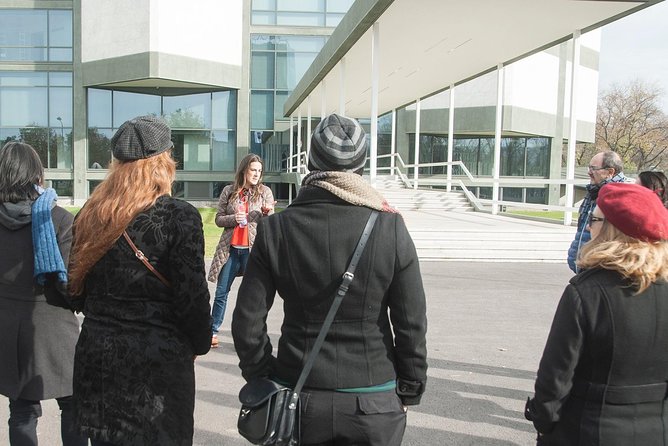
Your meeting point is in front of the Museum of Contemporary Art at Ušće 10. This is an easy place to find, and the tour begins with the building itself rather than a long introduction elsewhere.
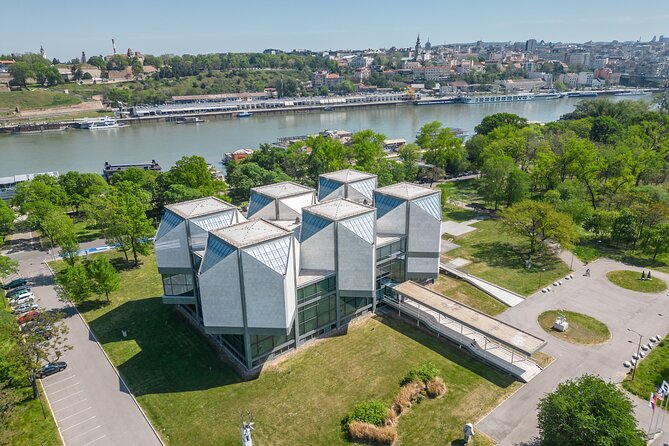
The museum’s 1960s design uses strong modernist volumes and carefully arranged geometric forms. The marble facades are especially useful for setting up the tour’s main idea: socialist-era buildings were not all cheap, rough, or visually severe.
The expensive marble challenges the common assumption that Yugoslav public architecture was built only from plain concrete. Here, the materials and shapes point to a state that wanted to present itself as modern, independent, and culturally confident.
You spend about 20 minutes here. That is enough for an architectural reading of the exterior, though not enough for a full museum visit. Admission to the museum is not included, so you should not expect this tour to function as an art collection visit.
If you want to see the museum’s exhibitions, treat that as a separate plan. The tour uses the building as a starting point for understanding New Belgrade, not as an indoor museum tour.
A couple more Belgrade trips to weigh up
- From Belgrade: Novi Sad & Sremski Karlovci Full-Day Tour
★ 4.7 · 1,068 reviews - From Belgrade: Gems of Eastern Serbia Tour
★ 5.0 · 427 reviews - Northern Serbia: Sremski Karlovci and Novi Sad Full-Day Tour from Belgrade
★ 5.0 · 425 reviews
The Park of Friendship and Yugoslavia’s Global Ambition
The next short stop is Park of Friendship, also called Park Prijateljstva. You spend about 15 minutes here, and admission is free.
The park connects New Belgrade’s architecture with the Non-Aligned Movement. In 1961, Belgrade hosted the founding meeting of this international group of 120 countries. Heads of state planted trees in the park as a sign of peace.
That detail gives the tour a welcome change of pace. Instead of looking only at concrete, you get a reminder that Yugoslavia followed its own political path after breaking with Stalin. Belgrade was not simply copying Moscow or following Western models. It was presenting itself as an independent voice between major power blocs.
The stop is brief, but it helps explain why New Belgrade received such ambitious public buildings. The city was not only expanding to house residents. It was also presenting Yugoslavia as a modern country with international influence.
A Passing View of the Government Building
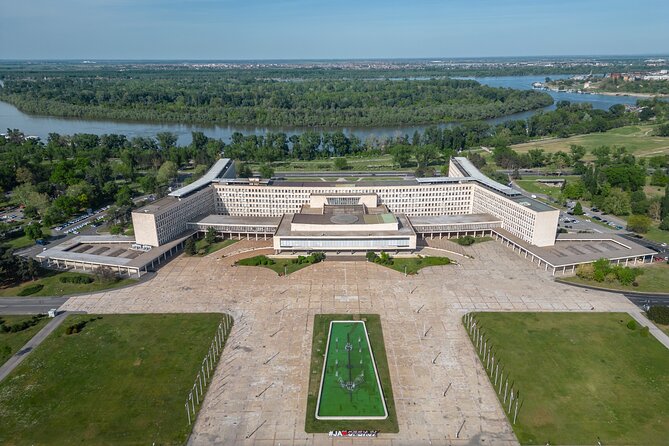
The route also takes you past the large Government Building. This is a drive-by rather than a full numbered stop, so your time here is limited.
Even so, the building offers an important political clue. Construction began during an earlier phase of Yugoslav policy, and the project experienced the country’s shift away from Stalin while it was still being built.
That makes the building useful as a marker of change. Architecture does not develop in a vacuum. A design can begin under one political mood and be completed under another.
You should expect explanation rather than a long visit. If government architecture is your main interest, this part may feel too quick. If you see it as a link between the museum, the park, and later modernist projects, it works well.
Genex Tower, Belgrade’s Western City Gate
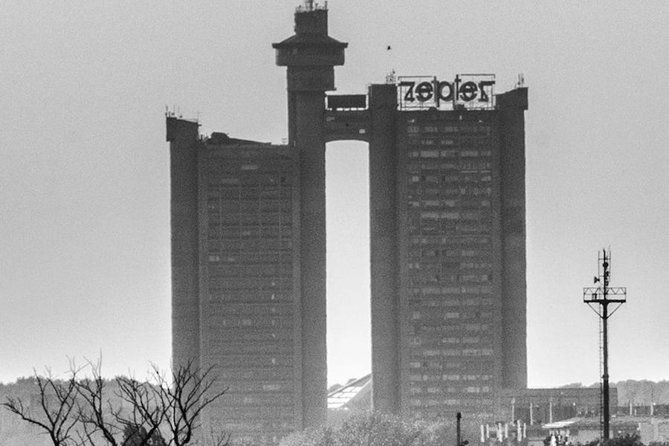
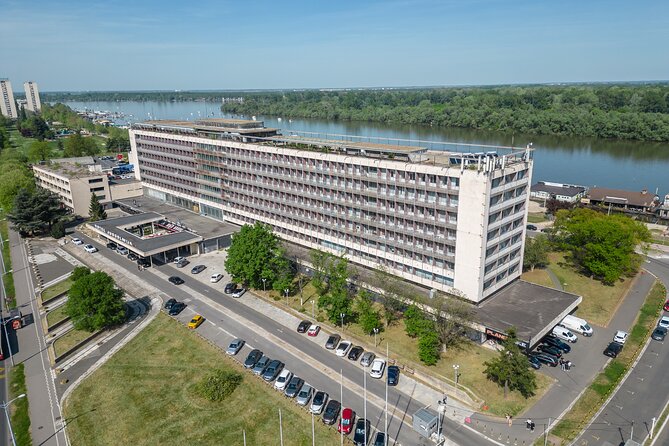
The tour’s most dramatic exterior stop is at Narodnih heroja 45, where you get a close view of Genex Tower, also called the Western City Gate of Belgrade.
The complex is a 30-floor structure that has become one of the city’s most photographed examples of brutalism. Built about 40 years ago, it was described as the first smart building in the Balkans and received attention in international architecture publications.
The nickname Western City Gate makes sense when you consider its position at the entrance to New Belgrade from the west. Its height and unusual form give the approach a strong visual marker. It is not a shy building, and it was never meant to disappear into its surroundings.
You spend about 20 minutes here. That gives you time to study the exterior, hear the design story, and take photographs. The tour does not promise a visit inside the tower, so you should come for the structure and its place in Belgrade’s modern identity.
I especially like this stop for first-time architecture visitors. You do not need a technical background to appreciate it. The guide can point out how the building works as an object, a gateway, and a statement about Yugoslavia’s confidence in modern design.
The site also shows why a guide adds value. A photograph can capture the shape, but not the political ambition or technological claims behind it. With a private guide, you can ask how the tower fits into New Belgrade’s wider plan.
Out of the city, and a slower way to spend the day:
- Day Trip from Belgrade: Gems of Eastern Serbia
★ 5.0 · 424 reviews - Belgrade: Sunset Cruise with Live Guide
★ 4.4 · 418 reviews - Belgrade: Underground Tour with Riverside Sparkling Wine
★ 4.8 · 411 reviews - Western Serbia 1-Day Tour of the Key Sites from Belgrade
★ 4.8 · 333 reviews
Sava Center, Built at Remarkable Speed
The final main landmark is Sava Center at Milentija Popovića 9. The tour ends here, which is convenient if you plan to continue around the modern business district or use public transportation afterward.
Sava Center is a huge congress complex built at the end of the 1970s in record time. It was the first building of its type in this part of Europe and remains in operation.
Its size can be hard to grasp from a quick photograph. The building was made for large meetings, performances, and international events, so it reflects the period’s interest in creating public spaces that could handle major gatherings.
The interiors are a key part of the explanation. The design includes solutions that still feel fresh after four decades. That is an important point, since brutalism is often judged only by its exterior concrete. Inside, the building can show more attention to movement, function, and public use than the style’s reputation suggests.
You spend about 15 minutes here. That is enough for an introduction, but it is not a full architectural survey of the complex. Because Sava Center is still functioning, the exact experience inside may depend on what areas are open during your visit.
Ending here gives the tour a strong chronological arc. You start with the 1960s museum, see the political and residential development of New Belgrade, and finish with a large late-1970s public building still serving its original purpose.
Block 23 and the Everyday Side of Concrete Expressionism
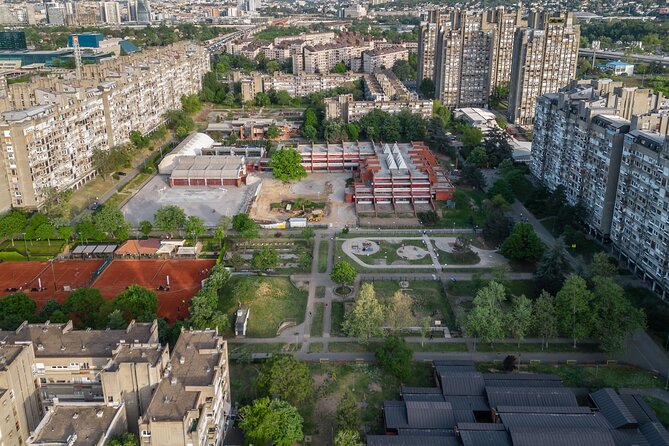
The most human stop is around Primary School Laza Kostić in Block 23. This area represents one of New Belgrade’s most complete public housing projects, designed in the style of concrete expressionism.
The important idea is not simply the look of the apartment buildings. The block was planned as a small community, with housing, a school, kindergarten, sports courts, and a mini shopping center. In theory, residents had many daily needs close to home.
This gives you a better sense of how New Belgrade was meant to work. The huge blocks were not random towers placed beside roads. They were part of a plan to create functioning neighborhoods for families and communities.
The guide also shares personal stories about life in the blocks during the 1960s, 1970s, and 1980s, when these neighborhoods were in their golden decades. You then hear about the harder reality of the 1990s.
That contrast is one of the tour’s strongest features. Architecture can look grand from a distance, but people experience it through school runs, shopping, playgrounds, neighbors, repairs, and changing economic conditions. The personal angle keeps the tour from becoming a procession of dates and architects.
One highly praised guide, Xenia, was noted for bringing everyday life into the discussion. That quality matters here more than a long list of technical terms. You want someone who can explain both the building and the people who lived around it.
You spend about 15 minutes at this stop. Again, the schedule is tight, so you should not expect to explore every courtyard, facility, or apartment block. The stop works best as an introduction to the planning concept and the social story behind it.
What the Private Format Adds
The private setup is more than a label. It means your group alone joins the guide, so the pace can be adjusted around your interests. You can ask about architectural details, Yugoslav politics, or daily life without waiting for a group discussion to end.
The experience also includes movement between stops, including a drive past the Government Building. That lets you cover a wide part of New Belgrade in a manageable period. Walking the entire route would take much longer and would make the 2-hour-30-minute schedule difficult.
The tradeoff is that short stops stay short. You get five main buildings or sites, plus the government building view, but the tour is an overview rather than a specialist field study.
One report described the actual experience as lasting under two hours and lacking warmth or preparation. That criticism is worth keeping in mind, especially because the published duration is approximate. Most of the available feedback is positive, but a private tour depends heavily on the guide you receive and how fully the schedule is followed.
Is $86.42 Good Value?
At $86.42 per person, this is not the cheapest way to see New Belgrade. The price makes more sense if you value private guiding, historical context, and transport between spread-out sites.
You are paying for more than photographs of Genex Tower. The tour connects architecture to the Non-Aligned Movement, Yugoslavia’s break with Stalin, changing political ideas, public housing, and the difficult 1990s. That context would take time to assemble on your own.
The value is strongest for couples, families, or small groups who want a focused experience in English. A private tour can also be worthwhile if you have limited time in Belgrade and want to see several major modernist sites in one outing.
The value is weaker if you only want quick photo stops. You can see some of these buildings independently, and the tour does not include museum admission. It is also not designed for people who want long interior visits or a detailed academic study of every structure.
The 92 percent recommendation rate and 4.6 rating from 24 ratings suggest a generally strong experience, but the sample is small. I would book it for the interpretation and personal attention, not simply for the number of buildings covered.
Who Should Book This New Belgrade Tour?
I would recommend it to anyone curious about modern architecture, Yugoslav history, urban planning, or the parts of Belgrade beyond the old center. It also suits photographers who want to understand the story behind the shapes they are shooting.
You do not need to know the difference between brutalism, modernism, and concrete expressionism before you arrive. The guide’s job is to make those ideas clear through actual buildings.
It may not suit you if your ideal tour includes museums, long walks, or many hours inside historic structures. The route is mainly about exteriors, urban planning, and explanation.
The tour is also a good choice if you prefer conversation over a fixed group script. Since only your party participates, you can use the time to focus on the topics that interest you most.
The meeting point is in front of the Museum of Contemporary Art at Ušće 10. The tour ends at Sava Center, so plan your day around that direction rather than assuming you will return to the starting point.
Free cancellation is available if you cancel at least 24 hours before the local start time. Changes or cancellations made later are not accepted for a refund.
Should You Book It?
Book this tour if you want New Belgrade explained rather than merely photographed. Genex Tower, Sava Center, the Museum of Contemporary Art, and Block 23 are much more meaningful when you understand the political aims and ordinary routines behind them.
I would be comfortable recommending it to architecture fans and curious first-time visitors, with one caution: the schedule is compact, and the experience can depend on the guide. If you want the best result, use the private format to ask questions and request more detail about the sites that interest you most.
Skip it if you want a cheap, self-guided look at a few concrete buildings. Choose it if you want a sharp, human introduction to the city Yugoslavia tried to build on the far side of the Sava.
FAQ
Where does the tour start?
The tour starts in front of the Museum of Contemporary Art at Ušće 10 in Belgrade, Serbia.
Where does the tour end?
The tour ends at Sava Center, Milentija Popovića 9, Belgrade 11000.
How long does the experience last?
The tour lasts approximately 2 hours and 30 minutes.
Is the tour offered in English?
Yes. The experience is offered in English.
Is this a private tour?
Yes. Only your group participates in the activity.
Is museum admission included?
No. Admission to the Museum of Contemporary Art is not included. The stop focuses on the building’s architecture.
How much does the tour cost?
The listed price is $86.42 per person.
Can I cancel for a full refund?
Yes, if you cancel at least 24 hours before the experience’s start time. Cancellations made less than 24 hours in advance are not refunded.
Just added in Belgrade
- Your Own Belgrade: Street Art and Hidden Gems Walking Tour★ 5.0 · 2 reviews
- Private Half Day Serbia Tour Novi Sad and Petrovaradin Fortress★ 5.0 · 3 reviews
- 3-Hour Belgrade Zemun Neighborhood Tour★ 5.0 · 8 reviews
- Private Belgrade Street Art and Adventures Walking Tour★ 5.0 · 4 reviews
- Private Wine Tasting by Party in Belgrade★ 5.0 · 3 reviews
- From Belgrade:Uvac Nature Reserve Tour★ 5.0 · 4 reviews
- Urban & Alternative Belgrade tour★ 5.0 · 4 reviews
- VIP Reservation Service in Belgrade★ 5.0 · 2 reviews
Belgrade Tours, compared.
Northern Serbia: Sremski Karlovci and Novi Sad Full-Day Tour from Belgrade
Read our review →
Day Trip from Belgrade: Gems of Eastern Serbia
Read our review →
Western Serbia 1-Day Tour of the Key Sites from Belgrade
Read our review →