
Reviewed · NOVI SAD & SREMSKI KARLOVCI TOURS
3 Hour Private Walking Tour in Novi Sad City
Novi Sad rewards slow walking. This private tour makes the city’s churches, courtyards, museums, and wartime memorials easier to understand, while keeping the pace personal and the price sensible. I especially like the small private format and the way the route connects Catholic, Orthodox, Jewish, Serbian, Croatian, Hungarian, and Austro-Hungarian influences. I also like that a coffee or lemonade is included.
The main thing to consider is transportation. The tour begins and ends in Novi Sad, not Belgrade, and you must arrange your own bus or train from Belgrade. The walk is also listed as about two and a half hours, despite its three-hour title, so you should not expect long interior visits at every museum or church.
In This Review
- Key points to know before booking
- Why Novi Sad works so well on foot
- Trg Slobode and the Name of Mary Church
- Zmaj Jovina Street and the city’s courtyards
- Svetozara Miletića Street and difficult wartime memory
- Grčkoškolska Street and Matica Srpska
- Orthodox tradition at Saborna crkva
- The Bishop’s Palace and a medieval Serbian style
- Fish Market and Dunavska Street
- The museum district and Danube Park
- Petrovaradin Fortress from the city side
- The Danube embankment and the 1942 massacre
- Civic power, Serbian art, and the synagogue
- Timing, transport, and physical effort
- Who should book this Novi Sad walk?
- Should you book it?
- FAQ
- Where does the Novi Sad walking tour begin?
- Where does the tour end?
- Is transportation from Belgrade included?
- How long does the walking tour last?
- How many people can join the private tour?
- Is coffee included?
- Can I enter the churches?
- Does the tour include entry to the museums or Petrovaradin Fortress?
- What happens if the weather is poor?
Key points to know before booking
- A private walk for up to four people: You get a guide focused only on your group, which is useful for questions and changes in pace.
- A history lesson told through buildings: Catholic and Orthodox churches, a synagogue, banks, theatres, galleries, and civic buildings all help explain Novi Sad.
- A route through serious wartime history: The walk includes the Novi Sad massacre of 1942 and the Monument to the Victims of Fascism.
- No transport from Belgrade: You reach Novi Sad independently by bus or train, keeping the tour price low.
- Coffee or lemonade included: Dunavska Street provides a short break at a non-smoking café.
- Guide Vadim receives special praise: He is described as lively, humorous, adaptable, and strong on history and art.
Why Novi Sad works so well on foot
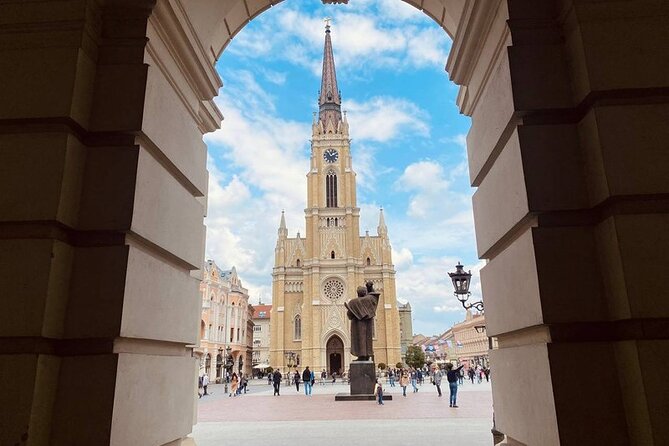
Novi Sad is compact enough to explore without a vehicle, and much of this route stays in the central area. You begin at Trg Slobode, the city’s main square, then move along pedestrian streets, older residential lanes, civic landmarks, the museum district, and the Danube embankment.
I like the basic idea here: instead of treating Novi Sad as a collection of pretty façades, the guide explains why those façades look different. The city’s architecture reflects the Austro-Hungarian period, Serbian Orthodox traditions, Catholic communities, Jewish life, and the role of Vojvodina in northern Serbia.
The private format matters. With a maximum of four people, you can ask why a building looks Central European, how Novi Sad became multinational, or how Serbian and Orthodox customs differ from Catholic traditions. The experience is better suited to curiosity than to simply collecting photographs.
The published price is $57.82 per group of up to four. That works out to about $14.46 per person if four people join, though the cost per person rises for a smaller group. For a private guide, a multi-hour route, and an included drink, I consider that good value, especially if you want context rather than a self-guided stroll.
Other days out to Novi Sad and the Karlovci cellars:
- From Belgrade: Novi Sad & Sremski Karlovci Full-Day Tour
★ 4.7 · 1,068 reviews - Northern Serbia: Sremski Karlovci and Novi Sad Full-Day Tour from Belgrade
★ 5.0 · 425 reviews - From Belgrade: Novi Sad and Sremski Karlovci Tour
★ 4.8 · 267 reviews
Trg Slobode and the Name of Mary Church
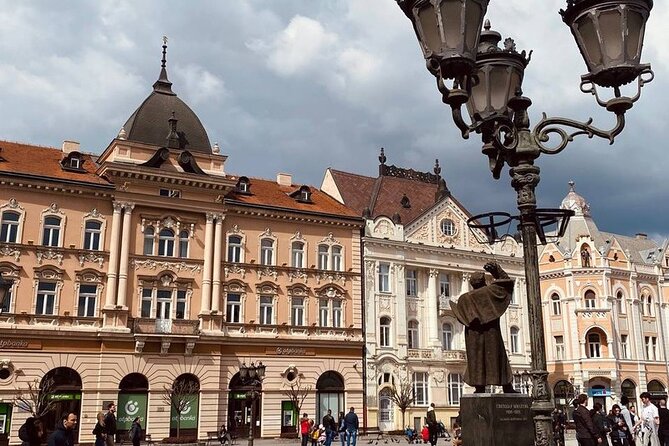
The walk starts in Freedom Square, or Trg Slobode, where the Name of Mary Church gives you an immediate introduction to Novi Sad’s Catholic heritage. It is the city’s main Catholic church, and you may look inside if the visit is possible.
The stop is brief, listed at about five minutes, so do not expect an extended architectural study. Its real value is as a starting point for understanding the city’s mix of religious and cultural traditions.
From here, the City Hall provides a useful contrast. You see the exterior and hear about the first Serbian mayor of Novi Sad, along with the monument made by a celebrated Croatian sculptor. This is where the guide explains how Novi Sad became a multinational city.
That explanation is one of the strongest parts of the tour. A city’s history can become a blur of dates, but the route ties identity to visible places. You see how public buildings, monuments, and churches reflect the people who shaped the city.
Zmaj Jovina Street and the city’s courtyards
Zmaj Jovina Street is Novi Sad’s main pedestrian thoroughfare. It is named after Jovan Jovanović Zmaj, one of Serbia’s best-known poets, and the route includes a stop at his monument.
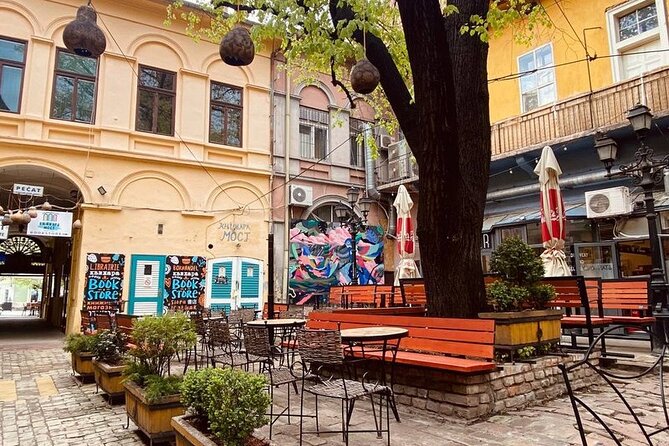
The street is not treated as a simple shopping corridor. You look into attractive courtyards and see a notable Bauhaus-style building. That combination is important. Novi Sad is not locked in one architectural period, and the route shows how older urban forms sit beside more modern design.
You should keep your eyes up and also look beyond the main façades. Courtyards often reveal more about a city than its grand squares, and the guide’s focus on these spaces helps you notice details you could easily miss alone.
Svetozara Miletića Street and difficult wartime memory
Along Svetozara Miletića Street, the tone changes. The group stops at a mansion connected with mass executions during World War II, then continues through one of Novi Sad’s most expensive areas.
This section gives the tour moral weight. You are not being shown only attractive streets and polished buildings. The route connects everyday urban spaces with the violence that took place there, then places that story within Serbia’s wider role in World War II.
The same stretch also includes several important architectural works, including one of Serbia’s oldest banks. A monument of Mercury sits on top of the building, giving you a memorable detail to watch for.
I appreciate the balance here. Architecture is not separated from politics, commerce, or tragedy. You see how a bank reflects the city’s economic life, while the mansion recalls a much darker chapter.
More guided walks around Belgrade:
- Belgrade: 3-Hour Small Group Walking Tour
★ 5.0 · 180 reviews - Belgrade: Shared Group or Private Guided Walking Tour
★ 4.8 · 162 reviews - Walking Tour in Belgrade
★ 4.8 · 122 reviews - Belgrade: 3-Hour Serbian History Walking Tour
★ 4.9 · 108 reviews
Grčkoškolska Street and Matica Srpska
Grčkoškolska Street was once home to some of Novi Sad’s wealthiest residents. The tour points out a famous merchant’s balcony and explains the building now associated with Matica Srpska, one of Serbia’s most important cultural institutions.
This is a good stop for understanding how private wealth helped shape public culture. A grand residence is not just an old house. It can reveal who had money, influence, and a role in supporting education and the arts.
At the Matica Srpska Library, the focus turns directly to national culture. The stop lasts about ten minutes, but the building’s importance reaches far beyond its exterior. You also hear the story of the street and its connection with Albert Einstein and his Serbian wife, who spent several months there.
The tour does not promise a full library visit, so you should think of this as an interpretive stop rather than an indoor museum experience. Still, it adds useful context to the city’s place in Serbian intellectual life.
Orthodox tradition at Saborna crkva
The Cathedral Church of Saint George, known as Saborna crkva, introduces the city’s Orthodox tradition. You may look inside if conditions allow, but the main purpose is to discuss architecture and religious practice.
The guide explains the influence of the Austro-Hungarian Empire on this part of Serbia and compares Orthodox and Catholic traditions. That comparison makes the earlier Name of Mary Church more meaningful. You are not seeing two unrelated religious buildings. You are seeing two parts of the same city’s past.
The stop is listed at around ten minutes. That is enough for a clear introduction, but not enough for a detailed examination of every icon, interior feature, or ceremony. If church interiors are especially important to you, ask the guide how much time can be given to them.
The Bishop’s Palace and a medieval Serbian style
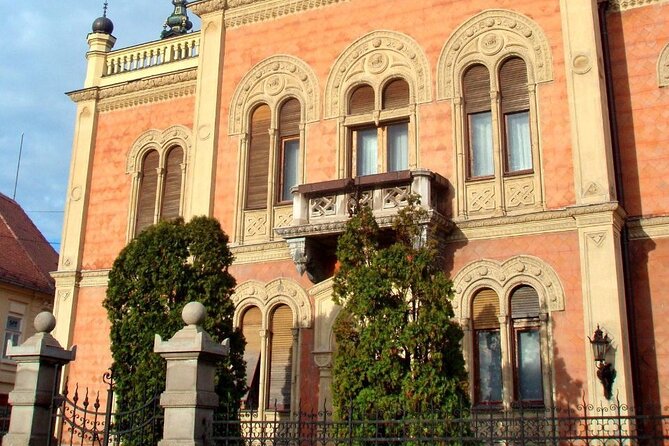
The Orthodox Bishop’s Palace is viewed from outside. Its design is presented as a more traditional Serbian style, with clear links to the southern parts of the country.
This contrast is one of the route’s more useful architectural lessons. Novi Sad contains Central European influences, but it also expresses Serbian religious and national identity. Seeing those styles close together helps you understand why the city feels different from Belgrade and from many other Serbian towns.
From the palace, the walk continues to the oldest Turkish well, dating to 1720, and to a historic mural showing important figures from the city’s past. These are the kind of smaller details that give a walking tour texture. They are easy to pass without a guide, yet they help turn a street into a place with layers.
Fish Market and Dunavska Street
At the Fish Market, you stop at the monument to King Peter I of Serbia and discuss his role in Serbian history. The market is also a place used by locals, particularly during evening events.
This stop gives the tour a more everyday setting after the formal churches and public buildings. Markets show how a city functions, not only how it commemorates itself. The visit is short, about ten minutes, so it is more of a guided look than a dedicated food market tour.
Dunavska Street is one of Novi Sad’s oldest streets and provides the planned break. You stop at a non-smoking café for coffee or lemonade, included in the price.
That detail will matter to some people more than it might seem. Non-smoking cafés can be difficult to find in Serbia, so a short, known break is welcome. Do not expect a long café session. The listed time is about ten minutes, but it gives you a chance to sit, drink, and ask questions before the final part of the route.
The museum district and Danube Park
The route then reaches the museum area, sometimes called the street of museums. Nearby institutions include the Museum of Novi Sad, with European masterworks, the Museum of Vojvodina, with archaeological exhibits, and the Museum of Contemporary Art, which presents temporary exhibitions.
The walk does not include extended museum admissions. You should expect to see the exteriors and receive an introduction to what each institution offers. If one museum interests you, note it for a separate visit after the tour.
Danube Park, founded at the end of the nineteenth century, provides a calmer setting. This is a useful pause in the urban route and a reminder that Novi Sad’s center includes formal gardens as well as monuments, galleries, and government buildings.
Petrovaradin Fortress from the city side
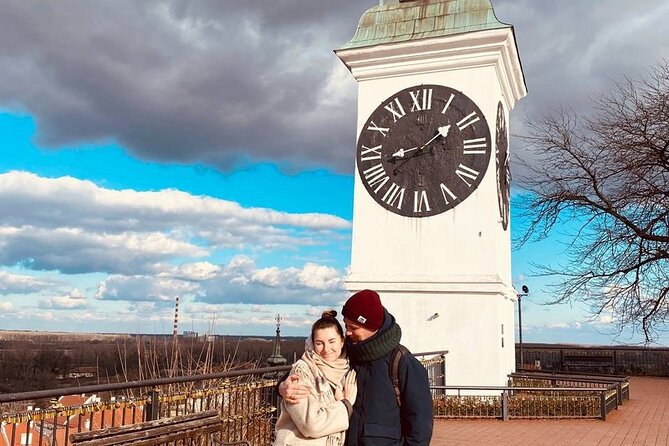
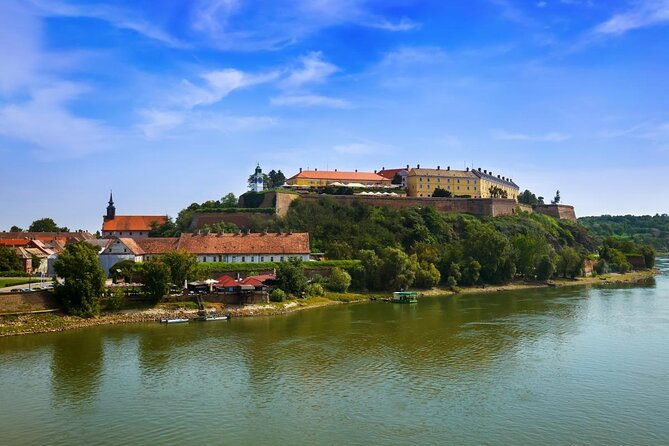
Petrovaradin Fortress is one of Novi Sad’s best-known symbols, but this walking tour views it from across the Danube rather than taking you inside. The fortress appears on the opposite bank, and the guide explains its role in the city’s development.
The fifteen-minute stop is valuable for orientation. It shows you how the Danube shaped Novi Sad and why the fortress matters to the city’s identity. You get the view without the added time required for a separate fortress visit.
This is also a clear limitation. If you want the fortress tunnels, clock tower, courtyards, or hilltop views, you need another excursion. This tour gives you the historical connection and the visual introduction, not a full Petrovaradin visit.
The Danube embankment and the 1942 massacre
At the Monument to the Victims of Fascism, the walk returns to the darkest part of Novi Sad’s story. The memorial is on the Danube embankment and relates to the Novi Sad massacre of 1942.
The guide discusses the events, Serbia’s role in World War II, and the foundation of Socialist Yugoslavia. This is a serious section, and it gives the city’s riverfront more meaning than a simple scenic stop would.
The visit is listed at about five minutes. That makes it concise, but the subject is large. You may want to ask questions and spend extra time at the memorial if the group is comfortable doing so.
Civic power, Serbian art, and the synagogue
The City Assembly is viewed from outside and used to explain how Novi Sad functions and why northern Serbia matters to the country. The building is considered especially impressive given the decade in which it was built.
At the Gallery of Matica Srpska, the guide points out the country’s leading gallery of Serbian art. Two other galleries are also located on the same square, one for modern art and one for contemporary art.
Again, this is an orientation rather than a gallery tour. I see that as a strength if you have limited time and want to choose your own museum afterward. It is a weakness if you want included entry and a close look at paintings.
The Novi Sad Synagogue is one of the route’s essential exterior highlights. It is no longer active as a synagogue and now functions as a concert hall. Designed by Lipot Baumhorn, it reflects the former importance of Novi Sad’s Jewish community.
The stop lasts around five minutes, so the emphasis is on the building and its place in the city’s history. You should not assume that the tour includes an interior concert hall visit.
The final stop is the Serbian National Theatre. Here, the guide explains the role theatre plays in national identity, answers questions, and offers recommendations. The tour then finishes back at the original meeting point.
Timing, transport, and physical effort
The walk is listed as approximately two hours and thirty minutes, while the title calls it a three-hour tour. In practice, timing may depend on questions, church access, the coffee break, and how long your group spends at the memorials.
You arrange your own transport from Belgrade. The experience provider specifically keeps the price down by not including private transportation, and Novi Sad is accessible from Belgrade by bus or train. Check your return plans carefully, since the walk itself begins and ends in Novi Sad.
You should have a moderate level of physical fitness. The route is a city walk with many stops, and the private format may allow some adjustment, but the available information does not promise a fully accessible route or special mobility arrangements. Service animals are allowed, and the starting point is near public transportation.
Confirmation arrives at booking. Free cancellation is available if you cancel at least 24 hours before the local start time. The walk requires good weather, so a weather cancellation results in an alternative date or a full refund.
Who should book this Novi Sad walk?
I would choose this tour if you want a first look at Novi Sad that mixes architecture, religion, art, politics, and difficult history. It suits couples, families, and small groups who prefer asking questions instead of following a large crowd.
The route is also a strong choice for first-time visitors arriving from Belgrade for the day. You get a clear map of the central sights, plus ideas for museums or Petrovaradin Fortress afterward.
I would hesitate if you want long indoor visits, a full fortress tour, or transportation included from Belgrade. You may also prefer a self-guided walk if you want to linger at every café, market stall, church, or gallery.
The guide is an important part of the decision. Vadim is praised for a lively sense of humor, strong knowledge of history and art, and an adaptable approach to the city’s streets and historical periods. The tour has a five-star rating from six published ratings, which supports the impression that the personal guiding style is a major strength.
Should you book it?
Book it if you value clear historical storytelling, a private group, and a broad central-city route at a reasonable group price. The best parts are the connections between Novi Sad’s communities, the architecture, and the events that shaped modern Serbia.
Skip it if your priority is private transport from Belgrade or detailed interior access to museums, churches, and Petrovaradin Fortress. For most visitors with a half-day in Novi Sad, though, this is a practical way to get oriented, see the major central sights, and leave with a much better sense of why the city looks the way it does.
FAQ
Where does the Novi Sad walking tour begin?
The tour begins at Trg Slobode in Novi Sad, Serbia.
Where does the tour end?
The activity ends back at the original meeting point.
Is transportation from Belgrade included?
No. Private transportation is not included. You must travel to Novi Sad independently, though the city is reachable from Belgrade by bus or train.
How long does the walking tour last?
The experience is approximately two hours and thirty minutes. It is marketed as a three-hour private walking tour.
How many people can join the private tour?
The price covers one private group of up to four people.
Is coffee included?
Yes. A stop includes coffee or lemonade, and coffee and tea are listed among the inclusions.
Can I enter the churches?
Interior visits to the Name of Mary Church and Saborna crkva are optional, subject to access at the time of the tour.
Does the tour include entry to the museums or Petrovaradin Fortress?
The provided details describe exterior stops and views. They do not state that museum or fortress admission is included.
What happens if the weather is poor?
The experience requires good weather. If it is canceled because of poor weather, you will be offered another date or a full refund. You can also cancel for a full refund if you do so at least 24 hours before the start time.
More 3-Hour Experiences in Belgrade
- Belgrade: 3-Hour Sightseeing City Tour
★ 4.9 · 54 reviews - 3-Hour Belgrade Zemun Neighborhood Tour
★ 5.0 · 8 reviews - Belgrade E-Bike Tour: 3h Journey Through History & Culture
★ 4.9 · 8 reviews - Belgrade: 3-Hour Walking Local Street Food Tasting Tour
★ 4.1 · 4 reviews
Just added in Belgrade
- Your Own Belgrade: Street Art and Hidden Gems Walking Tour★ 5.0 · 2 reviews
- Private Half Day Serbia Tour Novi Sad and Petrovaradin Fortress★ 5.0 · 3 reviews
- 3-Hour Belgrade Zemun Neighborhood Tour★ 5.0 · 8 reviews
- Private Belgrade Street Art and Adventures Walking Tour★ 5.0 · 4 reviews
- Private Wine Tasting by Party in Belgrade★ 5.0 · 3 reviews
- From Belgrade:Uvac Nature Reserve Tour★ 5.0 · 4 reviews
- Urban & Alternative Belgrade tour★ 5.0 · 4 reviews
- VIP Reservation Service in Belgrade★ 5.0 · 2 reviews
Novi Sad & Sremski Karlovci Tours, compared.
Northern Serbia: Sremski Karlovci and Novi Sad Full-Day Tour from Belgrade
Read our review →

Walking Tour city center and Petrovaradin Fortress
Read our review →
Private transfer from Belgrade or Belgrade Airport to Novi Sad
Read our review →
Private Day Tour to Fruska Gora Monasteries, Sremski Karlovci and Novi Sad
Read our review →
Private Novi Sad, Titanic wine tasting and Farmer’s House
Read our review →Browse the lists this tour appears in